


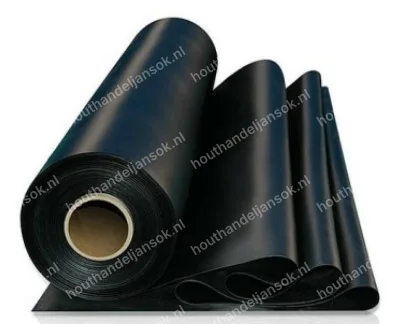
Short answer: a good EPDM substrate is level, dry and securely fastened. An 18 mm panel gives the flattest roof. Underlayment board of 1.22 × 2.44 m currently costs € 39.95 at our yard. Roof boarding also works and gives an attractive timber ceiling. But individual boards can cup, and you will see that through the EPDM. That is why many experienced contractors lay a panel on top of the boards.
EPDM substrate: four options
Each option has a different price and a particular disadvantage. This comparison places them side by side:
Substrate | Size and price | Flatness | Seen from below | Considerations |
|---|---|---|---|---|
1.22 × 2.44 m, € 39.95 | Good | Panel | Keep dry until the EPDM is on | |
1.22 × 2.44 m, € 69.70 | Good, stiff in both directions | Panel | More expensive | |
0.61 × 2.44 m, € 18.80 | Good | Panel | Half panel: more joints | |
18 × 145 mm, 3.00 m, € 9.90 | Fair: individual boards can cup | Timber ceiling | Also treated, € 8.70 |
Prices include VAT, as of 30 October 2026.
Why flatness matters so much
EPDM is a relatively thin synthetic rubber membrane. Every joint, screw head or raised board edge shows through. That is not just unattractive, because on a flat roof water collects in every dip. A board that deforms after a single summer creates a visible ridge underneath the membrane. A panel has fewer joints, and those joints all sit on a supporting joist.
Roof boarding or panel: which should you choose?
Choose a panel if
- you want a smooth roof without ridges;
- the underside is not on show, as in a shed;
- you want to work efficiently: one panel covers almost 3 m².
Choose roof boarding if
- you want to see timber from below, as in an open canopy;
- a few ridges in the EPDM do not bother you;
- you plan to add a panel on top of the boards.
Underlayment, plywood or OSB?
Underlayment is the most popular choice, because it is flat and affordable. Plywood is stiffer and stronger, but currently costs almost twice as much. OSB is inexpensive. We only stock 18 mm OSB as a half-size panel, 0.61 m wide, which inevitably creates additional joints. OSB does not cope well with long periods of wet. Also read is OSB waterproof. For more on sheet materials, see plywood or shuttering ply.
Thickness and joist spacing
For a shed or canopy roof, 18 mm is the typical thickness. That applies with joists at about 60 cm centres. Lay the long side of the panel across the joists. Let the short joints land on a supporting joist, and stagger them row by row.
Are the joists further apart? Or will people walk on the roof often? Then have the build up independently calculated by a structural engineer. We do not give a span table in this article.
Build in a fall
A flat roof is never completely horizontal; it must slope gradually towards the gutter. A commonly quoted rule of thumb is 1.5 to 2 percent, which is 15 to 20 mm per metre. Create the fall in the joists or with tapered firring strips, and only then lay the panel. That way no water stays on the roof.
Roof boarding with a panel on top
Want to see timber from below and have a smooth roof on top? Then lay roof boarding on the joists and a 9 or 18 mm panel on top. It is more expensive, but it also provides the foundation for a so-called warm roof. The build up is then: boards, vapour barrier, insulation, panel, EPDM. The vapour barrier always goes on the warm side, under the insulation.
Worked example: a 3 × 2 m roof
With overhang, the roof is about 3.40 × 2.10 m. That is just over 7 m².
- Panel: 3 panels of 18 mm underlayment, € 119.85 in total.
- EPDM: the narrowest roll is 3.66 m wide. Run that width along the 3.40 m long side. Then you need about 2.30 m, with a little extra for the edges. That is 2.30 × € 54.90 = € 126.27.
- Roof edge trim: for three sides without the gutter, that is about 7.60 m. That makes 4 lengths of 2.5 m, € 51.80 in total. Add corner pieces separately.
Always recalculate these quantities using your own measurements. If you are uncertain, send us your dimensions and we will verify them.
Before the EPDM goes on
- Screw the panel down securely. Fasten it approximately every 20 to 30 cm, and countersink the heads so nothing sticks out.
- Round off the edges. Sand sharp edges along the roof edge slightly, so the membrane does not tear when you fold it over.
- Clean the surface. No dust, sand or grease on the panel.
- Wait for dry weather. Only lay the EPDM once the panel is dry. Moisture trapped under the membrane cannot get out.
- Finish the edge. Use aluminium roof edge trim, € 12.95 per 2.5 m.
How to bond the EPDM is set out in the membrane manufacturer's instructions. We do not stock EPDM adhesive. For more on the membrane itself, see EPDM roofing and what is EPDM.
Mistakes we often see
- Wet timber under the membrane. The moisture cannot evaporate, so the panel swells and eventually deteriorates.
- Joints without a supporting joist below. The panel sags and a dip forms.
- Screw heads that stick out. Over time they gradually penetrate the membrane.
- No fall. Water accumulates, and dirt, algae and moss establish themselves.
Frequently asked questions
Can EPDM go directly on roof boarding?
Yes, if the boards are flat, dry and well fixed. Bear in mind that individual boards can cup. A panel gives a flatter result.
What panel thickness goes under EPDM?
18 mm is typical with joists at about 60 cm centres. With wider spacing, have the construction independently calculated.
Is OSB suitable under EPDM?
It can be, as long as the panel stays dry until the EPDM is on. We only stock 18 mm OSB as a half-size panel of 0.61 × 2.44 m, so you get more joints than with underlayment or plywood.
Does the EPDM substrate need treating?
No. Above all, the substrate must be clean, dry and flat. For adhesive or primer, follow the EPDM manufacturer's instructions.
What does the substrate cost for a 3 × 2 m roof?
With overhang, the roof is about 7 m². That is three panels of 18 mm underlayment, € 119.85 in total at € 39.95 per panel.