


This page was compiled by Andre Hassler (content specialist) for Houthandel Jan Sok in Meppel (Chamber of Commerce no. 04062841, timber merchant since 2000, 4.8 stars from 141+ Google reviews). We sell Douglas fir and Tenco stain from stock and see every day which combination gives which result.
The natural colour of Douglas fir
Douglas fir (Pseudotsuga menziesii) shows a clear colour difference between heartwood and sapwood. The heartwood is warm reddish-brown to pinkish-orange, with a pronounced, lively grain. The sapwood on the outside of the trunk is noticeably lighter: yellowish-white to light beige. In a pack of freshly sawn Douglas fir you will therefore see those two shades side by side, even within a single board.
That colour difference is not a defect but a characteristic of the species. It is worth knowing, though, that sapwood is less durable than heartwood; Douglas fir heartwood falls into durability class 3 under EN 350. You can read more about its properties and uses in what is Douglas fir, and you will find the range under Douglas fir.
There is no official "Douglas fir colour code": timber is a natural product and the colour varies from tree to tree, from cut to cut and even from board to board. If you need an exact colour, work with an opaque stain rather than the natural shade.
Weathering to grey: what happens if it is left untreated?
Untreated Douglas fir changes colour under the influence of UV radiation and moisture. UV breaks down the lignin in the top wood fibres and rain washes the breakdown products away; what remains is a silver grey to greyish-brown surface layer. On a sunny, exposed facade or canopy this happens noticeably within one to three seasons.
Weathering to grey is cosmetic, not decay: the structural strength of the timber is unaffected. What you will notice is that the process is uneven. Boards under an overhang or on the north side grey more slowly, so for a while you will see patchy transitions. Over time this largely evens out. How to maintain or reverse the greying is covered in Douglas fir maintenance.
Colour reference table
| Condition | Description | Approximate RAL | How to achieve it |
|---|---|---|---|
| Fresh Douglas fir | Warm reddish-brown heartwood with yellowish-white sapwood, lively grain | Roughly within the RAL 8001-8014 range (indicative, no official code) | Natural, no treatment |
| Weathered, untreated | Silver grey to greyish-brown, matt surface | Roughly RAL 7006 (indicative) | UV weathering, 1-3 seasons outdoors |
| Tenco Tuindecor transparent | Grain stays visible, the tint deepens the wood colour | Not applicable: transparent follows the wood colour | Transparent stain, 2 coats |
| Tencomild anthracite | Dark grey, uniform opaque finish | Roughly RAL 7016 (indicative) | Opaque stain, 2 coats |
| Tencomild black | Black, uniform opaque finish | Roughly RAL 9004 (indicative) | Opaque stain, 2 coats |
| Tencomild oak or mahogany | Warm brown shades, from light brown to reddish-brown | Roughly within the RAL 8000 range (indicative) | Opaque stain, 2 coats |
Important: all RAL references in this table are approximate and indicative. Tenco does not publish official RAL codes for its stains, and the final colour on timber always differs from a RAL swatch on flat sheet material: the substrate, the grain, the number of coats and the absorbency of the wood all affect the result. If you want certainty about the shade, always make a test piece on the same timber from the same batch first.
Which stain for Douglas fir?
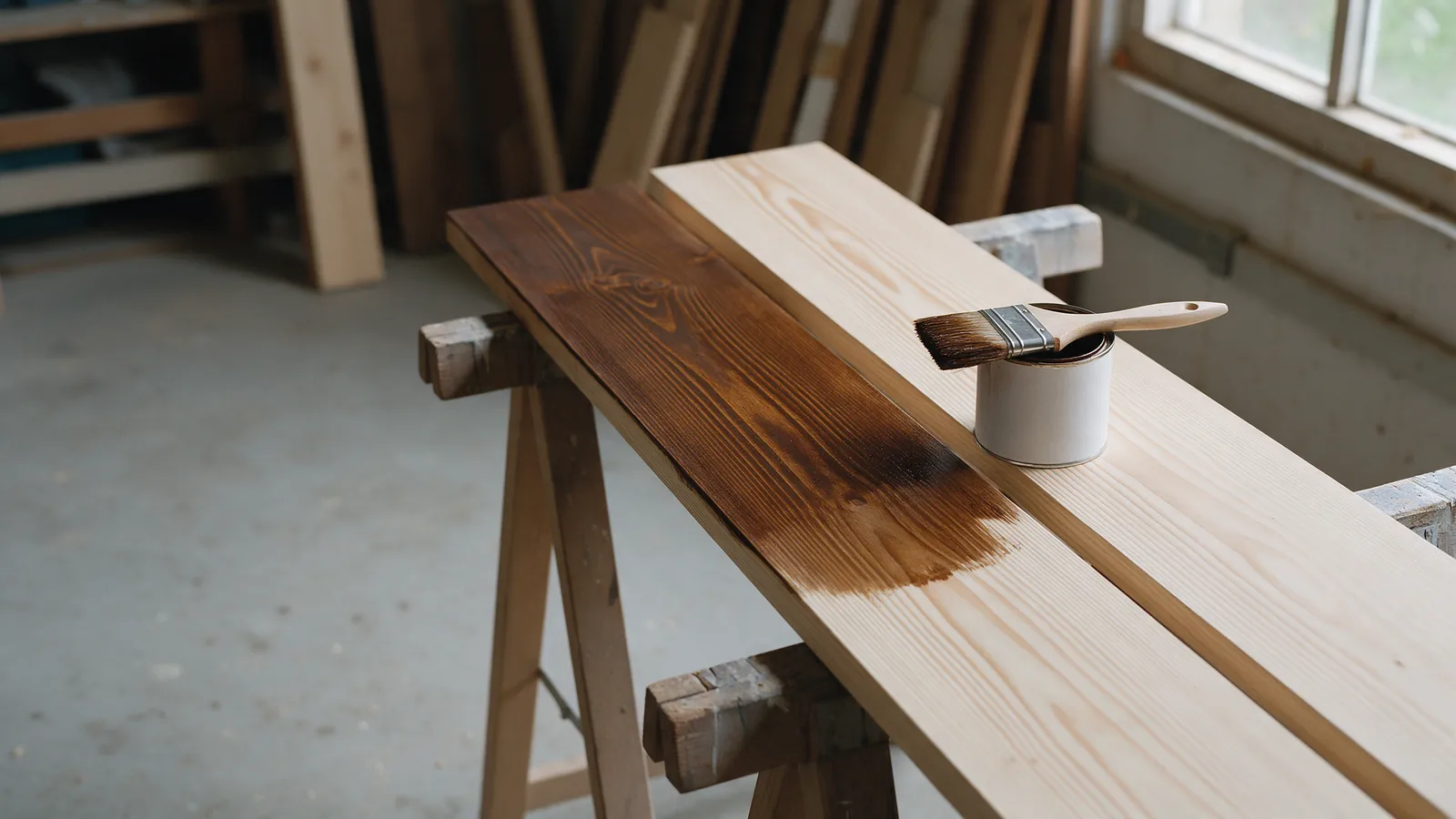
For Douglas fir we work with two lines. Tenco Tuindecor is transparent: the stain soaks in, deepens the colour and leaves the grain fully visible. That is the choice if you want to keep the character of Douglas fir. Tencomild is opaque and gives a uniform colour, for example anthracite or black; it lets you control the colour completely, even across the difference between heartwood and sapwood. The full explanation per product is on Tenco stain, and the range is under paint and stain.
Three practical points that make the difference. First: give the end grain extra treatment, because that is where the timber draws in moisture like a straw and where almost every problem starts. Second: apply two coats, even with transparent stain; a single coat gives too little UV protection. Third: stain in dry weather above 10 degrees and not in full sun, otherwise the stain dries too quickly on the surface.
Expect maintenance after two to four years, depending on how much sun and rain the surface takes. South-facing walls and horizontal boards need attention sooner than a sheltered north side. That maintenance usually means cleaning and a fresh coat, not sanding right back. For facade work, cladding is a logical next read.
Prevent greying or let it happen?
In the end this is a matter of taste, not a technical one. Letting it weather needs no maintenance: you accept the silver grey patina and the timber stays structurally sound. For a pergola, a fence or a rustic carport that is a perfectly good route, and it saves on materials and labour.
Keeping the colour does take work. A UV-resistant transparent stain or a wood oil holds the warm tint for longer, but needs checking and touching up every one to two years; in practice oil needs more frequent maintenance than stain. You cannot stop weathering completely: you slow it down.
Has it already greyed and do you want to go back? Then clean the timber with a wood cleaner or grey remover, let it dry thoroughly and stain it afterwards. Sanding is also possible, but takes considerably more time on a whole facade. For a new project it is best to choose your route in advance, because staining fresh, clean timber is always easier than correcting it later. Questions about your own situation? Call 0522 851 551 or request a quote.
Frequently asked questions
What colour is fresh Douglas fir?
Fresh Douglas fir has warm reddish-brown to pinkish-orange heartwood and noticeably lighter, yellowish-white sapwood, with a lively grain. That colour variation within a board or pack is normal and not a defect. There is no official colour code for Douglas fir, because the shade differs from tree to tree and from cut to cut.
Which RAL colour matches Douglas fir?
There is no official RAL colour for Douglas fir. As an approximation, fresh Douglas fir sits in the RAL 8001-8014 range and weathered Douglas fir around RAL 7006, but that is indicative only. A RAL swatch is a flat, uniform colour, whereas timber has grain, colour variation and sheen; so always make a test piece on the same timber.
Which stain should I use for Douglas fir?
For a visible grain, use a transparent stain such as Tenco Tuindecor; for a uniform colour such as anthracite or black, use an opaque stain such as Tencomild. In both cases apply two coats and give the end grain extra treatment, because that is where moisture gets in fastest. Expect maintenance after two to four years.
How do I stop Douglas fir weathering to grey?
Weathering is caused by UV radiation and moisture and cannot be stopped completely, only slowed down. A UV-resistant transparent stain in two coats or a wood oil slows the process most effectively, provided you repeat the treatment in time. Shelter under an overhang also makes a noticeable difference in practice.
How do I keep the natural colour of Douglas fir?
Treat the timber shortly after installation, before it starts to grey, with a transparent UV-resistant stain or wood oil in two coats. Check it every year and touch up sun-exposed and horizontal surfaces sooner than sheltered parts; in practice oil needs more frequent maintenance than stain. If the timber has already greyed, clean it first with a grey remover, let it dry and then treat it.