


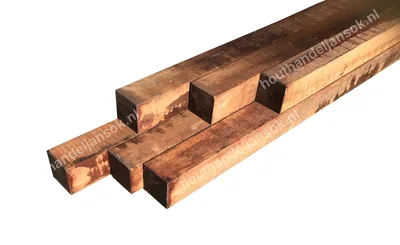
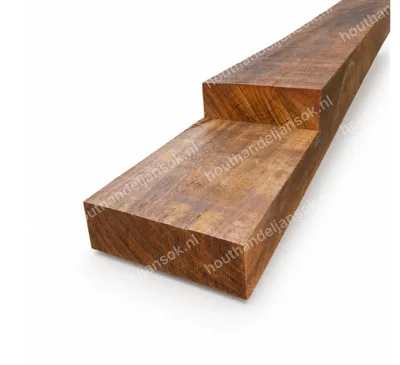
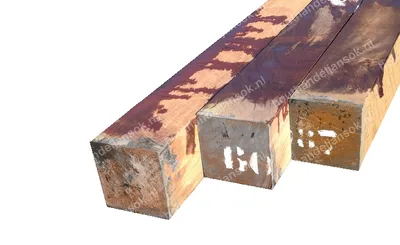
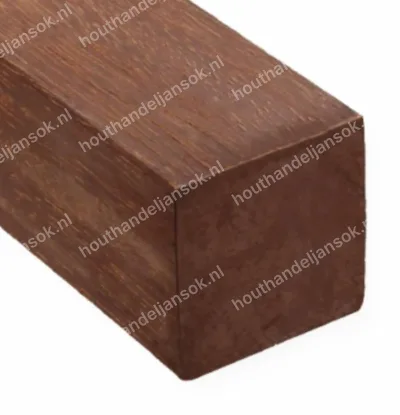
What is Okan? Okan is a tropical hardwood whose heartwood is rated durability class 1 under EN 350, the highest class. It has an expected service life of more than 25 years, including in direct ground contact, without any treatment. The wood is supplied fine-sawn, is very strong and resists rot and insects on its own. That makes Okan a logical choice for posts, beams and structures that stand in the ground (use class 4 under EN 335).
At Houthandel Jan Sok in Meppel we sell Okan posts, beams and boards of traceable origin, in lengths up to 5 metres. We have been trading since 2000 (KvK 04062841), are rated 4,8 stars from more than 141 reviews, and supply homeowners, tradespeople and contractors from the same stock. This guide covers what Okan is, its properties, its uses and how to look after it.
What Okan is
Okan is a dense West African hardwood. Its natural durability means it resists fungi, insects and moisture for a very long time without treatment. It is often mentioned alongside Azobe and Tali. The main difference is in how they are used: Azobe is the classic choice for work in water, while Okan is mostly used for structures in the ground, such as fence posts, pergolas, boundary fences and load-bearing beams. For decking, see Okan vs Tali for decking.
Properties and durability class
Okan combines properties that you rarely find together in one species:
- Class 1 under EN 350 — very durable, with a service life of more than 25 years, also in ground contact.
- Permanent ground contact (use class 4) — posts can go straight into the ground.
- Fine-sawn and dense — a smooth surface that works well with sharp tools.
- Very strong — high bending and compressive strength, suited to load-bearing structures.
- Traceable origin — sourced from managed forests.
Uses: posts, beams and boards
We supply Okan in three main formats:
- Posts — from 50 × 50 mm, for fencing, pergolas and structures set directly in the ground.
- Beams — 50 × 100 to 50 × 200 mm, for canopies, deck frames and other load-bearing work.
- Boards — for cladding and fencing where a smooth, fine-sawn finish is wanted.
Because Okan can stay in the ground, you do not need concrete pads or post bases. The post goes straight in, which saves material and avoids weak joints. For work that stays above ground, Douglas is often the cheaper option. See hardwood vs Douglas.
Pros and cons
Pros
- A long natural service life (class 1, more than 25 years) without treatment.
- Suitable for permanent ground contact, so no concrete pads are needed.
- Very strong and fine-sawn.
- Traceable origin.
Cons
- Denser and heavier than softwood, so you need sharp tools.
- More expensive than impregnated pine or Douglas.
- Untreated, it weathers to grey.
Care and maintenance
Okan needs very little care, which is exactly why people choose it. Left untreated, it weathers to an even grey without any loss of strength. If you want to keep the original colour, oil it from time to time. Clean it once a year with water and a soft brush to remove algae and moss. For posts in the ground, check the fixings and the area where the post enters the soil once a year.
Need strong, durable timber for a structure in the ground? See our hardwood range for Okan posts, beams and boards, in stock in Meppel.
Frequently asked questions
Is Okan suitable for permanent ground contact?
Yes. Okan heartwood is class 1 under EN 350 and suitable for use class 4: direct, permanent ground contact. Posts can go straight into the ground without a concrete pad or treatment.
What is the difference between Okan and Azobe?
Both have class 1 heartwood, but they are used differently. Okan is mainly used for structures in the ground. Azobe is heavier and is the usual choice for work in water, such as sheet piling and bank protection.
How long does Okan last?
Okan heartwood has an expected service life of more than 25 years, including in ground contact, without treatment.
Does Okan need to be treated?
No. Okan resists rot and insects on its own. Untreated, it turns grey, which only changes the look. Oil is optional if you want to keep the colour.