


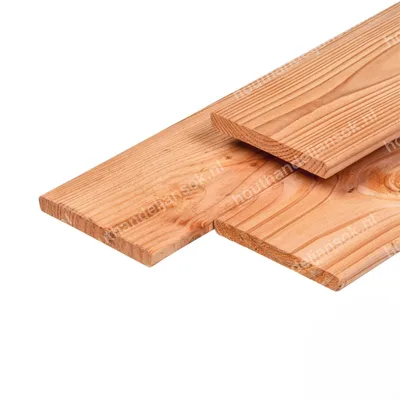
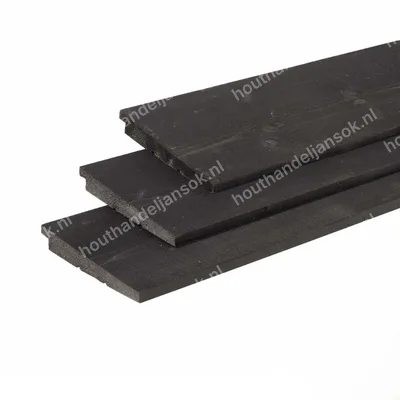
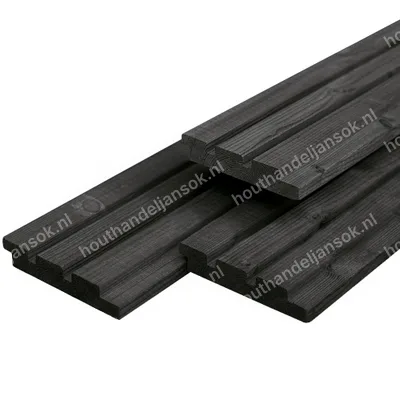
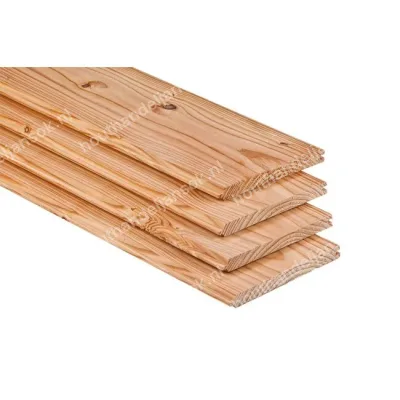
What is rabat? Rabat is a type of timber cladding board with an overlap, so each board covers the edge of the next. It gives a closed wall that keeps the weather out. You see it a lot on facades, fences and garden houses. At Houthandel Jan Sok in Meppel we supply rabat mainly in Douglas. It is a warm red-brown softwood in class 3 under EN 350. The two main types are Swedish rabat and overlapping (potdeksel) boards.
What rabat is
Rabat boards are profiled so that one board overlaps the next. The overlap sends rain down the outside of the wall instead of into the joint. That makes rabat a natural choice for facades, fences and garden buildings that are exposed to wind and rain. In the timber trade, rabat is almost always made from softwood, often Douglas. Douglas is strong, fairly light and easy to work. You can let it turn grey or finish it with oil or stain. For more on this, see our cladding page.
Types: Swedish rabat and overlapping boards
Swedish rabat is the most common type. The boards are fixed level, with a rebate that laps over the next board. This gives a neat, closed wall with a clear shadow line. It is the standard choice for cladding and closed fences.
Overlapping boards (potdeksel) are simple boards. Each upper board laps over the one below, a bit like roof tiles. This gives a more rustic look with stronger shadow lines and sheds water well.
Both types are in stock in Douglas. See our Douglas range.
What rabat is used for
- Facade cladding — rabat is the standard for timber cladding. Depending on the finish, the look can be modern or traditional. Fixing is explained in our rabat cladding installation guide.
- Fences — Swedish rabat makes a closed, windproof fence without gaps, for privacy and shelter.
- Garden houses — walls of garden houses and sheds are often clad in rabat.
Pros and cons
Pros: the overlap keeps rain out and gives a neat look. It is light and easy to work, and in Douglas it costs much less than hardwood. You can let it turn grey or oil it.
Cons: Douglas is class 3, so it is not suitable for ground contact. Untreated Douglas generally lasts 10 to 15 years above ground. Good detailing matters more than the finish. Keep the bottom of the cladding clear of the ground, let water drain and let the wood dry. Untreated wood turns grey, which only affects the look.
Care
Untreated rabat weathers to a silver-grey tone without losing strength. To keep the warm colour, treat it with oil or stain every one to two years. Clean the facade once a year with water and a soft brush to remove algae and dirt. Check the overlaps for damage and replace damaged boards in good time, so moisture cannot get in behind them.
Frequently asked questions
What is the difference between Swedish rabat and overlapping boards?
Swedish rabat has a rebated overlap that gives a neat, closed wall with a shadow line. Overlapping (potdeksel) boards simply lap over each other, like roof tiles, for a more rustic look.
Can rabat touch the ground?
No. Douglas rabat is class 3 and is not suitable for ground contact. Keep the cladding clear of the ground and set posts on concrete pads or post bases. For ground contact, choose hardwood such as Okan or Azobe (class 1).
Do I have to treat rabat?
No. Untreated rabat turns grey, which only affects the look. To keep the warm colour, oil or stain it every one to two years.
Is rabat weatherproof?
Yes. The overlap sends rain down the face of the wall, so the cladding stays closed and dry behind.