


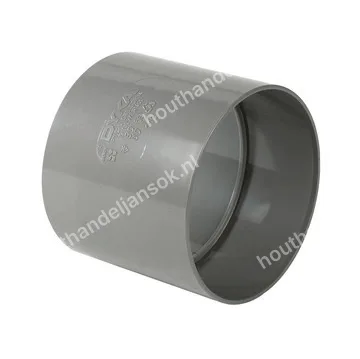
Click the image to see the section size and grain
| Brand | Houthandel Jan Sok |
|---|---|
| Finish | Grijs |
| Material | polyvinylchloride |
| Volume | 1 piece |
| Stock | 100 in stock |
Product description
A PVC solvent-weld coupler Ø50 joins two 50 mm drain pipes with a solvent-welded, watertight joint. You come across Ø50 where more water comes together than a single washbasin discharges: on the kitchen waste with dishwasher and sink, and on collector pipes to which, for example, a washbasin, shower and washing machine connect together before the pipe enters the soil stack. Because grease and food scraps come along in a kitchen waste, sufficient fall is important; otherwise dirt builds up at the joints. So finish the solvent-weld joint neatly: pipe cut square, inside deburred so there is no lip for dirt to catch on, and always degreased with PVC cleaner. You use a coupler in new builds or when you are replacing a section of pipe anyway. Order your coupler online from Houthandel Jan Sok, then collect it at Celsius 10 in Meppel or have it delivered to your home.
Key features
- Ø50: for drain pipe with an outside diameter of 50 mm.
- Solvent-weld joint: durable and watertight with PVC solvent cement.
- For larger volumes of water: suitable for kitchen and collector pipes.
- Smooth inside: after proper deburring, there is little room for dirt to build up.
- PVC: resistant to household waste water.
Applications
Suitable for, among other things:
- Kitchen waste with sink and dishwasher.
- Collector pipe for several sanitary fixtures.
- Waste from a utility room or laundry room.
- Extending a 50 mm pipe to the soil stack.
Fits
Use this coupler on:
- PVC drain pipe Ø50.
- Spigot ends of PVC fittings Ø50, such as bends, tees and reducers.
- A reducer 50 x 40 or 50 x 32 if you are connecting a smaller branch.
Installation
- Cut to length: cut the Ø50 pipes square with a fine-toothed saw or pipe cutter.
- Deburr: remove burrs and slightly chamfer the outer edge of the spigot.
- Degrease: clean the pipe ends and the inside of the coupler with PVC cleaner.
- Solvent weld: spread PVC solvent cement lengthwise on pipe and socket and push the pipe up to the stop in one movement, without twisting.
- Check the fall: use a spirit level to lay the pipe to a fall towards the soil stack before the cement cures.
- Cure: let the joint cure as stated on the cement packaging before running water through the pipe.
Product specifications
| Property | Value |
|---|---|
| Type | solvent-weld coupler (straight coupling) |
| Diameter | Ø50 mm |
| Connection | solvent-weld joint with PVC solvent cement |
| Material | PVC |
| Volume | 1 piece |
For beginners
Beginner
This is a connector for two 50 mm drain pipes, as you often see at the kitchen. You glue both pipes into it with PVC solvent cement. Make sure the pipe runs slightly downhill.
- Tools
- Fine-toothed saw or pipe cutter
- Deburring tool or file
- PVC cleaner and clean cloth
- PVC solvent cement
- Spirit level
- Also needed
- pvc-afvoerbuis-50-200m
- pvc-verloopring-centrisch-50-x-40-spie-mof
- pvc-ophangbeugel-met-schroef-50
- How to calculate
- You buy this per piece.
- Common mistake
- Kitchen pipes are often laid too flat, causing grease to build up at the joints. Check the fall with a spirit level before the cement cures.
PVC solvent-weld coupler Ø50
Delivery and pickup
-
Pickup in Meppel: Free (ready after confirmation)
-
Truck delivery with a Moffett: €125 fixed delivery charge
-
Free delivery on orders from €2,500
Cut-to-size or custom-processed timber is non-returnable. Stock lengths: see returns policy.
Frequently asked questions
Is a PVC solvent-weld coupler Ø50 suitable for the kitchen waste?
Yes, Ø50 is a common size for kitchen waste and collector pipes. The coupler joins two 50 mm pipes watertight.
How do I connect a 40 mm waste to a 50 mm pipe?
With a reducer 50 x 40 in the socket of the 50 mm pipe. The Ø50 coupler itself only fits 50 mm pipe.
Why do I need to deburr PVC pipe before solvent welding?
Because a burr scrapes the cement out of the socket and forms a lip inside where dirt catches. Deburring gives a better joint and a smoother flow.