


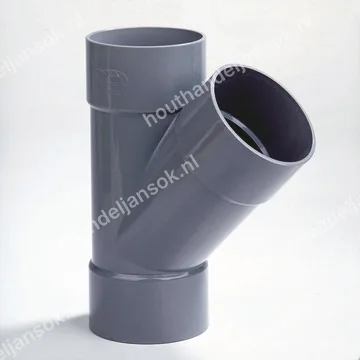
Click the image to see the section size and grain
| Brand | Houthandel Jan Sok |
|---|---|
| Finish | Grijs |
| Material | polyvinylchloride |
| Volume | 1 piece |
| Stock | 100 in stock |
Product description
With this PVC tee 45 degrees Ø50 with 3x socket you create an angled branch in a 50 mm waste pipe. You mainly come across this size in kitchen waste and in collector pipes where several smaller wastes come together before discharging into the soil stack. All three ends are solvent weld sockets. Grease and food scraps come along in a kitchen waste. A gradual inflow at 45 degrees helps keep that waste flowing smoothly, because the water from the side branch does not crash against the main flow. If you want to connect a Ø40 pipe to this branch, use a reducer in the side socket. Also plan a place for a rodding access point near the kitchen. Easily order this tee online; we deliver across the Netherlands or you can collect it from Houthandel Jan Sok at Celsius 10 in Meppel.
Key features
- Ø50 mm: For PVC waste pipe with an outside diameter of 50 mm.
- Angled 45-degree branch: Gradual inflow from the side pipe.
- 3x solvent weld socket: Pipe ends glue straight in.
- PVC: Resistant to normal domestic waste water.
- Collecting function: Ideal for combining wastes on a Ø50 pipe.
Applications
Suitable for uses such as:
- Kitchen waste with an extra connection for a second sink bowl.
- A collector pipe where shower, washbasin and washing machine come together.
- A branch in a horizontal pipe in a crawl space or under the floor.
- Replacing a damaged tee in an existing Ø50 pipe.
Combine with
- PVC waste pipe Ø50 mm.
- A 50 x 40 or 50 x 32 reducer for a smaller side pipe.
- Bends Ø50 socket/spigot for the onward run of the pipe.
- A universal trap Ø50 under the kitchen sink.
Installation
How to make a reliable solvent-weld joint:
- Cut to length: Cut the pipe square with a fine-toothed saw or pipe cutter.
- Deburr: Remove burrs inside and out and lightly chamfer the outer edge of the pipe end, so the cement is not pushed out of the socket.
- Degrease: Clean the pipe end and the inside of the socket with PVC cleaner.
- Glue: Apply PVC solvent cement to the pipe end and thinly inside the socket, then immediately push the pipe straight in up to the stop in the socket.
- Curing: Hold the joint for a few seconds and only put it under load after the drying time stated on the cement packaging.
Product specifications
| Property | Value |
|---|---|
| Material | PVC |
| Diameter | Ø50 mm (outside diameter of the pipe to be connected) |
| Branch angle | 45 degrees |
| Connections | 3x socket (solvent weld socket) |
| Jointing method | solvent-weld joint |
| Product group | indoor drainage / waste |
| Volume | 1 piece |
For beginners
Beginner
This tee is intended for 50 mm wastes, such as in the kitchen. You use it to let a second waste join at an angle, so the water flows through smoothly.
- Tools
- Fine-toothed saw or pipe cutter
- Deburring tool or file
- PVC cleaner and PVC solvent cement
- Tape measure
- Also needed
- pvc-afvoerbuis-50-400m
- pvc-ophangbeugel-met-schroef-50
- pvc-verloopring-centrisch-50-x-40-spie-mof
- abs-universele-sifon-50
- How to calculate
- Sold per piece.
- Common mistake
- People sometimes glue a Ø40 pipe directly into a Ø50 socket with lots of cement as filler. That leaks; always use a reducer.
PVC tee 45 degrees Ø50 3x socket
Delivery and pickup
-
Pickup in Meppel: Free (ready after confirmation)
-
Truck delivery with a Moffett: €125 fixed delivery charge
-
Free delivery on orders from €2,500
Cut-to-size or custom-processed timber is non-returnable. Stock lengths: see returns policy.
Frequently asked questions
Is a PVC tee 45 degrees Ø50 suitable for kitchen waste?
Yes, Ø50 is a common size for kitchen wastes and collector pipes. The 45-degree branch ensures a smooth inflow.
How do I connect a 40 mm pipe to this tee?
With a 50 x 40 reducer that you glue into the side socket. Then glue the Ø40 pipe into the reducer.
How much fall does a kitchen waste need?
A horizontal waste must always slope slightly towards the soil stack. Too little fall leaves standing water, too much can siphon the trap empty; if in doubt, follow the Dutch Bouwbesluit (building regulations) or ask an installer.