

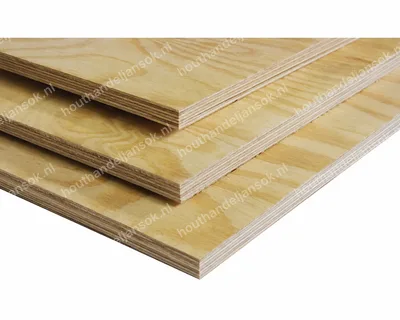
Varnish or stain underlayment? Often you do neither. If the board lies under laminate, vinyl or carpet, you don't treat it, because the board needs to be able to release moisture. If the board stays visible, choose varnish. Varnish forms a film and seals, whereas stain only adds colour.
Why you shouldn't varnish a subfloor
This feels odd, so we will explain briefly. An underlayment subfloor sits between the screed and the floor. There is almost always still moisture in it, and that moisture has to go somewhere. Apply varnish and you seal the top. The moisture then stays between board and floor, and that is where you get mould and a musty smell.
What you do need to do is keep moisture out, with a membrane, air under the floor and room to move, not with a tin of varnish.
Varnish or stain: what does what?
| Varnish | Stain | |
|---|---|---|
| Effect | Forms a film on the surface | Soaks into the wood |
| Moisture protection | Yes, seals | Hardly at all |
| Colour | Clear or tinted | Colour and some UV protection |
| Wear | High, can flake later | Low, wears away evenly |
| Touching up | Sand and re-varnish | Re-staining is often possible straight away |
If you want colour and protection, stain first and then varnish over the stain. The other way round does not work, because stain cannot get through varnish. See our range of paint and stain for the products.
Step-by-step: varnishing underlayment
- Let the boards acclimatise for two days in the room itself. If you treat them too early, the varnish cracks as the board moves.
- Sand lightly with 120 grit and remove all the dust. Without sanding, the first coat adheres poorly.
- Apply a base coat, ideally a water-based primer for boards. That way the board doesn't absorb unevenly.
- Give the end grain edges extra attention, and the cut edges too. That is where the core is exposed and the board absorbs the most. Almost everyone skips this step.
- Apply the first coat of varnish and let it dry. Follow the time on the tin and then sand lightly.
- Apply the second coat. For a floor or a heavily used wall, a third coat is no luxury.
- Don't forget the underside if the board hangs free or rests on battens. Untreated wood on the back absorbs moisture and then the board warps.
Treating underlayment against moisture
First the limit, because it matters: underlayment is an indoor board and no varnish will turn it into an outdoor board. For outdoors, use concrete plywood or fibre cement. Indoors, these points make the difference:
- Treat all six sides. The underside and cut edges are often skipped, and that is exactly where the board absorbs moisture.
- Never lay the board on wet ground. On concrete, use a damp-proof membrane with overlapping seams.
- Let the boards acclimatise. Two days in the room, so they move less after laying.
- Leave expansion space: about 10 mm along walls and 2 mm between the boards. Without a gap the floor will push up and start creaking.
- Make sure there is air under the floor. A crawl space without airflow lets the board soak up moisture, and then no varnish will help.
How do you know if it is too damp?
A moisture meter is the most reliable; for a cement screed the limit is about 2 percent, and above that value you wait before laying. Without a meter, the foil test gives a hint. Lay a piece of plastic of about 50 × 50 cm flat, tape down the edges and leave it for 24 hours. If you see condensation under the plastic, the floor is still too wet.
Our underlayment boards
We supply two thicknesses, both in full size 1.22 × 2.44 m: 9 mm for €17.80 (€5.98 per m²) and 18 mm for €35.70 (€11.99 per m²), incl. VAT, as of July 2026. For a subfloor use 18 mm, whereas 9 mm flexes on joists 40 cm or more apart and is used for walls and ceilings. Thicknesses such as 12 or 15 mm are not in stock: ask us whether we can order them.
In short
You usually don't need to varnish a subfloor, as long as it stays dry, the edges are properly finished and a good floor goes on top. Is the room damp? Then first find the cause of the moisture and only then decide whether varnish or stain is still needed.
Tips from the yard
Store the boards dry and let them acclimatise for a few days in the room where they will be fitted. Finish the edges neatly and use underlayment indoors only; for wet rooms, choose a different type of board. If you do varnish or stain, apply thin coats and let each coat dry properly. That keeps the floor nice and flat.
Frequently asked questions
Should I varnish or stain underlayment?
As a board under laminate, vinyl or carpet you do neither, because the board needs to be able to release moisture. If the board stays visible, you varnish, because varnish forms a film that seals. Only need colour: stain. If you want both, stain first and varnish over it afterwards.
How do I protect underlayment against moisture?
Treat all six sides, including the underside and the cut edges. Never lay the board on wet ground and use a damp-proof membrane on concrete. Let the boards acclimatise for two days, keep about 10 mm of space along walls and make sure there is air under the floor. Underlayment remains an indoor board: for outdoors, use concrete plywood or fibre cement.
Is underlayment moisture-resistant?
To a limited extent, and it is not an outdoor board. Underlayment copes with normal indoor air, but not with standing water or a wet substrate. Always use a damp-proof membrane on concrete.
Which varnish do I use on underlayment?
A water-based varnish, for floors or furniture, over a primer for boards. Two coats as a minimum, three on a floor. Treat the end grain edges separately and generously, because that is where moisture gets in fastest.
Do I need to treat the underside of underlayment?
If the board hangs free or rests on battens, yes. If one side stays bare, it absorbs moisture while the other side is sealed, and then the board warps.
How long does underlayment need to acclimatise?
Allow two days in the room and lay the boards flat, with battens in between so that air can get to them. Skip this step and the board will keep moving after laying, leaving you with gaps or a warped surface.