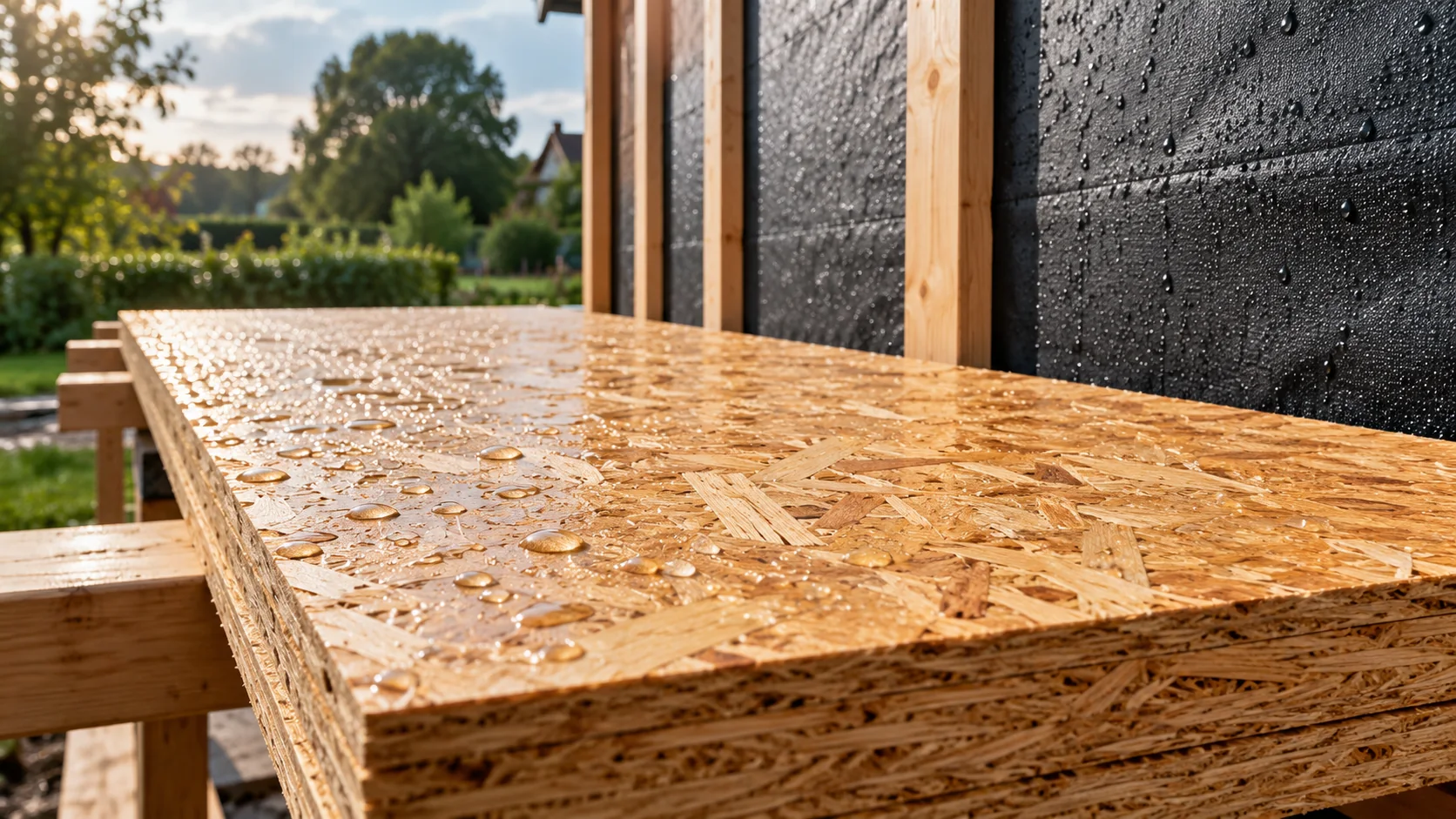


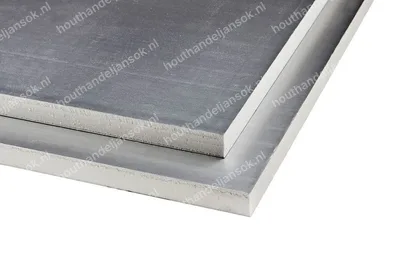
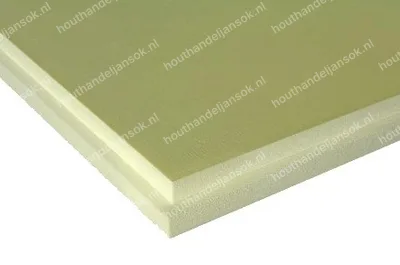
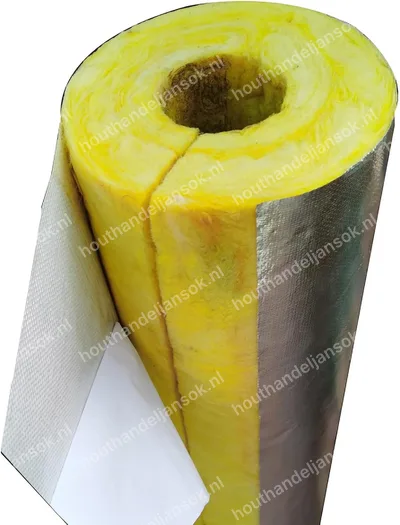
Short answer: a vapour control layer belongs on the warm side of the insulation. In a house, garden office or heated shed, that is the inside. On the outside, where needed, goes a breathable membrane. Swap them round? Then you trap moisture in the wall. We stock both membranes 1.50 m wide at €1.10 per metre.
Why does the membrane go on the warm side?
Warm air inside holds more vapour than cold air outside. That vapour wants to get out. It passes straight through the wall or roof. On its way out it gets colder and colder. At some point it gets so cold that the vapour turns to water. That is called the dew point. That is where condensation forms.
The membrane on the warm side holds the vapour back. So it does not reach the cold part. No moisture then gets into the wall. Timber stays dry, and the wool or PIR stays in good condition.
The rule: sealed inside, open outside
Each layer towards the outside should let vapour through a little more easily than the layer before it. Does some moisture get in anyway? Then it can escape to the outside. The bigger that difference, the safer the wall or roof.
Two membranes, two jobs
The names are similar, but the jobs are very different. This shows you at a glance which membrane goes where:
Membrane | Position | Job | At Jan Sok |
|---|---|---|---|
Vapour control layer | Warm side of the insulation (inside) | Holds back vapour from the room | |
Breathable (vapour-permeable) | Cold side of the insulation (outside) | Keeps out wind and rain, lets vapour through | Vistex, 1.50 m, €1.10 per metre, or Megatec, 1.50 m, €2.15 per metre |
Vapour control layer on the outside | Wrong | Traps moisture in the insulation | Don't do it |
Prices include VAT, as of 26 October 2026.
What does the sd value tell you?
The roll often shows an sd value in metres. The higher that number, the less vapour gets through. A vapour control layer scores high. Depending on the brand, that is around 2 m to more than 100 m. A breathable membrane scores very low. That is often below 0.1 m. Not sure which roll you have? Then look at this number.
Which side in which situation?
Warm flat roof with EPDM
Lay the vapour control layer on the roof deck. The insulation goes on top of it. The EPDM above is already vapour-tight itself. So no second membrane goes on the outside. Also read what EPDM is.
Pitched roof, insulation between the rafters
The vapour control layer goes on the inside, against the rafters, in front of the board. On the outside goes a breathable membrane. It sits under the battens. See also choosing PIR thickness.
Timber wall with façade cladding
The vapour control layer goes on the inside. On the outside goes a breathable membrane, behind the battens. That way the wall can dry out towards the outside. See battens behind façade cladding.
Cold shed without insulation
No vapour control layer belongs here. There is no warm side with vapour to seal off. Fresh air does the work here.
Does there always need to be a membrane?
No, not always. Do you heat the space? Is there insulation? Then yes. Is the space cold and open? Then no. When in doubt: better one good membrane on the inside, properly sealed, than two half-done jobs. And in any case make sure air can flow along the cold side.
How to fit a vapour control layer in 6 steps
- First check the wool or PIR. It must be dry and fill the space well, without gaps.
- Roll out the membrane. Start at the floor or on one side. Keep it taut. Don't tear it.
- Fix it in place. Not too many staples, and always in the overlap.
- Overlap the strips. Keep at least 10 cm of overlap.
- Tape all seams. Use tape made for membranes. Also tape the edges at floor, wall, roof and window.
- Seal every hole. A pipe or cable through the membrane? Use a sealing collar or tape it shut all the way round.
How much membrane do you need?
First work out the m². Divide that by the width of the roll. Add 10 per cent for overlap and offcuts.
Example: your roof is 4 by 3 m. That is 12 m². With a roll 1.50 m wide, that is 8 linear metres. With 10 per cent extra you come to 9 metres. With Vistex that costs around €9.90. Do add the tape.
Three mistakes we often see
- Seams not sealed. A membrane only works once it is sealed as one continuous surface. An open seam lets a lot of vapour through. That is more than the membrane itself holds back.
- Holes for pipes and boxes. Every socket or light fitting through the membrane is a leak. Where possible, work with an extra batten in front of the membrane. The pipes go in there. That keeps the membrane intact.
- Two sealed layers. A membrane inside and a vapour-tight board outside is a moisture trap. Whatever gets in can no longer get out.
What if the membrane is already on the wrong side?
Is the vapour control layer on the outside? Then deal with it quickly. First check whether the wool is wet or smells musty. If so, remove the wet parts. Then fit the membrane on the warm side. Not sure? Send us a photo and the build-up. We'll take a look with you.
Where can you buy membranes and insulation?
At Jan Sok in Meppel you'll find membranes, tape, PIR, stone wool and glass wool. Boards and timber for finishing are also ready for you. Take a look in the shop. Or ask us for advice on your roof or wall. We're happy to help.
Frequently asked questions
Which side of the insulation does a vapour control layer go on?
On the warm side. In a warm room in the Netherlands, that is the inside, between the insulation and the finish.
What is the difference between a vapour control layer and a breathable membrane?
A vapour control layer holds back vapour and belongs on the inside. A breathable membrane keeps out wind and water, but lets vapour through. It belongs on the outside of the insulation or the sheathing.
Do I need a vapour control layer in a shed?
Only if you insulate and heat the shed. In a cold shed without insulation, fresh air is much better than a membrane.
How much overlap should a vapour control layer have?
Keep around 10 cm of overlap and tape the seams. Also follow the advice on the roll.
Can a vapour control layer go on the outside?
No. Then vapour from the room turns to water in the wall, and the moisture has nowhere to go. Only a breathable membrane goes on the outside.