


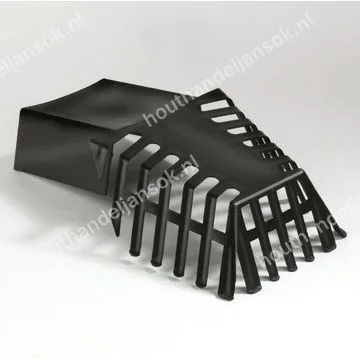
Click the image to see the section size and grain
| Brand | Houthandel Jan Sok |
|---|---|
| Finish | Zwart |
| Material | Polyethyleen |
| Thickness | 60mm |
| Width | 80mm |
| Volume | 1 piece |
| Stock | 100 in stock |
Product description
You fit this PE leaf trap type U 60x80 at the outlet of your gutter, so leaves, twigs and moss do not end up in the downpipe. The size designation 60x80 refers to the downpipe sizes it is intended for: the common rainwater systems from Ø60 to Ø80 mm, as found on houses, sheds, garages and carports. It is made of PE (polyethylene), a plastic that does not rust and can take a knock outdoors. You often only notice a blocked downpipe when the gutter overflows or the water runs down the wall. With a leaf trap, the coarse debris stays at the top, where you remove it by hand, instead of deep in the drain or sewer. Check the leaf trap a few times in autumn in particular, because a full leaf trap slows down drainage just as much. You simply order it online and have it delivered, or collect it from Houthandel Jan Sok at Celsius 10 in Meppel.
Key features
- PE material: polyethylene is rustproof and stays usable outdoors.
- Size 60x80: intended for downpipe outlets in the size range Ø60 to Ø80 mm.
- Type U: the version designated type U in this product line.
- Accessible debris: leaves stay caught at the top and can be removed by hand.
- No tools needed: you fit and clean it by hand.
Applications
Suitable for, among other things:
- Gutters with a Ø60, Ø70 or Ø80 mm downpipe.
- Houses with trees or shrubs close to the roof.
- Sheds, garages, summerhouses and carports with their own gutter.
- Rainwater drainage that discharges into a water butt or soakaway crate, where you do not want leaves.
Suitable for
The leaf trap is intended for these downpipe sizes:
- PVC downpipe Ø60 mm.
- PVC downpipe Ø70 mm.
- PVC downpipe Ø80 mm.
- Gutter outlets and scupper outlets in the size range 60 to 80 mm.
Installation
- Clear the gutter: first remove loose leaves and debris around the outlet from the gutter.
- Fit: place the leaf trap in the opening of the gutter outlet, so the water runs through it into the downpipe.
- Check: pour a bucket of water into the gutter and see whether the water drains away freely.
- Maintenance: regularly remove the collected leaves in autumn, so the gutter does not overflow.
Product specifications
| Property | Value |
|---|---|
| Material | PE (polyethylene) |
| Type | U |
| Size designation | 60x80 |
| Application | rainwater drainage (gutter/downpipe) |
| Sales unit | 1 piece |
| Volume | 1 piece |
For beginners
Beginner
You place a leaf trap in the opening where the gutter meets the downpipe. This keeps leaves in the gutter and stops your downpipe getting blocked. Make sure the size matches your downpipe: this one is for Ø60 to Ø80 mm.
- Tools
- Ladder
- Work gloves
- Bucket of water for testing
- Also needed
- pvc-regenpijp-80-x-15mm-400m
- pvc-stadsuitloop-kort-60x80-voor-70-80
- pvc-bolrooster
- How to calculate
- You buy this leaf trap per piece; allow one per downpipe.
- Common mistake
- The most common mistake is fitting it and then forgetting it: a full leaf trap makes the gutter overflow just as badly. Set a reminder to check it in autumn.
PE leaf trap type U 60x80
Delivery and pickup
-
Pickup in Meppel: Free (ready after confirmation)
-
Truck delivery with a Moffett: €125 fixed delivery charge
-
Free delivery on orders from €2,500
Cut-to-size or custom-processed timber is non-returnable. Stock lengths: see returns policy.
Frequently asked questions
Does the PE leaf trap type U 60x80 fit an 80 mm downpipe?
Yes, the size designation 60x80 means it is intended for downpipe outlets from Ø60 up to and including Ø80 mm. A Ø80 downpipe therefore falls within that range.
How often should I clean a leaf trap in the gutter?
That depends on the trees nearby, but in autumn it is sensible to check once every one to two weeks. For the rest of the year, a few times a year is usually enough.
Why a leaf trap instead of a gutter guard along the whole length?
A leaf trap protects exactly the point where things go wrong: the transition from gutter to downpipe. It is inexpensive, quick to fit and you remove the debris from one place.