


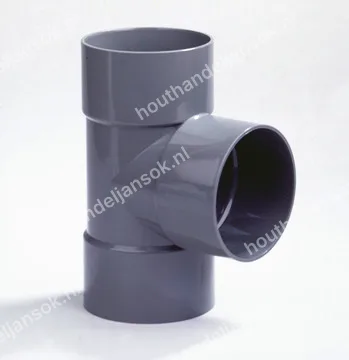
Click the image to see the section size and grain
| Brand | Houthandel Jan Sok |
|---|---|
| Finish | Grijs |
| Material | polyvinylchloride |
| Volume | 1 piece |
| Stock | 100 in stock |
Product description
You use the PVC 90-degree tee Ø110 with 3 sockets to connect a pipe at right angles to a 110 mm drain pipe. The typical example is a soil stack into which the toilet waste joins at right angles on each floor, or a vent pipe that runs straight up to the roof from the top of the soil stack. All three connections are solvent-weld sockets. In a vertical soil stack a right-angled branch works well, because the water falls down past it. In horizontal drain runs, for example in the crawl space, a 45-degree tee is the better choice for joining pipes. For a toilet connection, make sure the branch is at the right height relative to the toilet pan and the floor, and check this before you bond. You order this tee online from Houthandel Jan Sok at Celsius 10 in Meppel and choose for yourself: collection or delivery.
Key features
- Ø110 mm: Standard size for toilet waste and soil stacks.
- 90-degree right-angled branch: Compact on vertical pipes.
- 3x solvent-weld socket: Three bondable connections.
- PVC: Strong and light drainage material.
- Also for venting: Branch straight up to the roof outlet.
Applications
Commonly used for:
- Connecting a toilet at right angles to a Ø110 soil stack.
- The vent at the top of a soil stack.
- A right-angled connection in a service duct.
- Replacing an old tee in an existing soil stack.
Connects to
- PVC drain pipe Ø110 mm.
- Bends Ø110 socket/spigot or socket/socket.
- Eccentric reducers 110 x 75, 110 x 50 and 110 x 40.
- Pipe clips Ø110 with screw.
Installation
How to make a reliable solvent-weld joint:
- Cut to length: Cut the pipe square with a fine-toothed saw or pipe cutter.
- Deburr: Remove burrs inside and out and lightly chamfer the outer edge of the pipe end, so the solvent cement is not pushed out of the socket.
- Degrease: Clean the pipe end and the inside of the socket with PVC cleaner.
- Bond: Apply PVC solvent cement to the pipe end and thinly inside the socket, and immediately push the pipe straight in up to the stop in the socket.
- Check the height: For a toilet connection, measure the height of the branch relative to the floor before you bond.
Product specifications
| Property | Value |
|---|---|
| Material | PVC |
| Diameter | Ø110 mm (outside diameter of the pipe to be connected) |
| Branch angle | 90 degrees |
| Connections | 3x socket (solvent-weld socket) |
| Jointing method | solvent-weld joint |
| Product group | indoor drainage / waste |
| Volume | 1 piece |
For beginners
Intermediate
You usually use this 110 mm right-angled tee in an upright soil stack, for example to connect a toilet. For horizontal pipes an angled tee is better.
- Tools
- Hand saw or pipe saw
- File or deburring tool
- PVC cleaner, PVC solvent cement and brush
- Spirit level
- Tape measure
- Also needed
- pvc-afvoerbuis-110-200m
- pvc-ophangbeugel-met-schroef-110
- pvc-bocht-90-graden-110-mof-mof
- pvc-verloopring-excentrisch-110-x-75-spie-mof
- How to calculate
- You buy this tee per piece.
- Common mistake
- A right-angled tee is often used in a horizontal pipe to join two wastes, which causes backing up. Only use the right-angled model where the water comes from above.
PVC 90-degree tee Ø110 3x socket
Delivery and pickup
-
Pickup in Meppel: Free (ready after confirmation)
-
Truck delivery with a Moffett: €125 fixed delivery charge
-
Free delivery on orders from €2,500
Cut-to-size or custom-processed timber is non-returnable. Stock lengths: see returns policy.
Frequently asked questions
Can I connect a toilet to a PVC 90-degree tee Ø110?
Yes, in a vertical soil stack a toilet is often connected via a 110 mm right-angled tee.
Is a right-angled tee suitable for a horizontal drain run?
Preferably not for joining wastes. In horizontal pipes a 45-degree tee gives better flow and less chance of blockage.
Can I use this tee to vent my drain?
Yes, at the top of the soil stack you run a vent pipe to the roof using a right-angled or straight tee.