


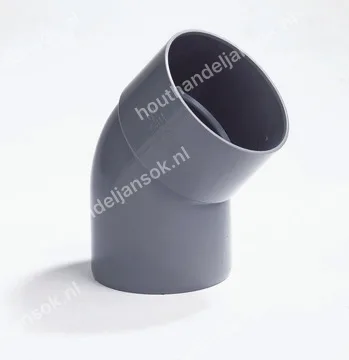
Click the image to see the section size and grain
| Brand | Houthandel Jan Sok |
|---|---|
| Finish | Grijs |
| Material | polyvinylchloride |
| Volume | 1 piece |
| Stock | 100 in stock |
Product description
The PVC bend 45 degrees Ø75 socket/spigot is a grey bend with one solvent-weld socket and one spigot end, intended for pipes with a 75 mm outside diameter. You use it in stacks without a WC, for the drainage of a roof terrace or in a rainwater pipe that runs indoors or underground. The spigot end fits directly into the socket of another Ø75 fitting, for example a 45 degree tee or a second bend. Two of these bends fitted together give a compact offset that lets you route a stack past a floor edge or joist. Fit the bend with the spigot in the direction of flow, so the water runs over the glued seam. On vertical pipes, fix the pipe with clips close to the bend so the joint does not have to carry any weight. You can order online, with delivery across the Netherlands or collection from Houthandel Jan Sok at Celsius 10 in Meppel.
Key features
- Solvent-weld socket and spigot end: fits directly into a socket of another Ø75 fitting.
- Ø75 mm: for stacks without a WC and indoor rainwater drainage.
- 45 degree angle: for a smooth offset.
- Grey PVC: standard version for drainage.
Applications
Suitable for, among other things:
- A compact offset in a Ø75 stack.
- Rainwater running indoors to a gully or underground pipe.
- The drainage of a roof terrace or balcony.
- Connecting to the socket of a tee without an intermediate pipe.
Fits / combine with
Fits on and in:
- The socket of a PVC 45 degree tee Ø75.
- PVC waste pipe Ø75 mm in the solvent-weld socket.
- An eccentric reducer 110 x 75 for the connection to the sewer.
- A PVC solvent-weld coupler Ø75 to connect the spigot to a pipe.
Instructions for use
Step-by-step connection:
- Cut to length: cut the Ø75 pipe square with a fine-toothed saw or pipe cutter and deburr the cut inside and out.
- Set the position: dry-fit the bend and mark a line showing how it should sit; once glued, you can no longer turn it.
- Degrease: clean the spigot end and socket with PVC cleaner; grease or dust prevents a good bond.
- Apply cement: spread PVC solvent cement lengthways on both bonding surfaces and push the parts together straight away, right up to the stop.
- Check the fall: on horizontal runs, check that the fall is correct before the cement sets.
Product specifications
| Property | Value |
|---|---|
| Material | PVC |
| Angle | 45 degrees |
| Diameter | Ø75 mm (outside diameter of the connecting pipe) |
| Connection | solvent-weld socket / spigot |
| Colour | Grey |
| Volume | 1 piece |
For beginners
Intermediate
This bend is for 75 mm pipes, such as a stack or an indoor rainwater pipe. You push the smooth end into another fitting, and glue the pipe into the other end.
- Tools
- Fine-toothed saw or pipe cutter
- Deburring tool or file
- Folding rule or tape measure and pencil
- Clean, lint-free cloth
- Also needed
- pvc-afvoerbuis-75-200m
- pvc-t-stuk-45-graden-75-3x-mof
- pvc-verloopring-excentrisch-110-x-75-spie-mof
- pvc-ophangbeugel-met-schroef-75
- How to calculate
- You buy this bend per piece.
- Common mistake
- A vertical pipe that hangs only on its glued joints can crack over time. Fix the pipe with a clip just above and below each bend.
PVC bend 45 degrees Ø75 socket/spigot
Delivery and pickup
-
Pickup in Meppel: Free (ready after confirmation)
-
Truck delivery with a Moffett: €125 fixed delivery charge
-
Free delivery on orders from €2,500
Cut-to-size or custom-processed timber is non-returnable. Stock lengths: see returns policy.
Frequently asked questions
Can I use a PVC bend 45 degrees Ø75 socket/spigot for rainwater?
Yes, Ø75 is also used for rainwater drainage running indoors or in the ground. On the outside of the facade, downpipes are usually 60, 70 or 80 mm.
How do I make an offset in a stack with this bend?
Push the spigot of one bend into the socket of the second bend, or put a piece of pipe in between. This shifts the pipe sideways, after which it continues straight again.
Which end of the bend do I push into the next fitting?
The spigot, the smooth end. It points in the direction of flow and goes into the socket of the next fitting.