

You can find more on this topic on our page timber fence panels and fences; prices are listed under fence costs.
Short answer: you buy fence boards and fence panels from roughly three types of seller. DIY stores such as Gamma, Hornbach and Praxis for the lowest base price. Garden timber webshops such as Garden Adventure and Tuinhout-direct for convenience and home delivery. And local timber merchants such as Jan Sok in Meppel for advice at the counter, cutting to size and heavy timber sections.
Three types of seller
Anyone looking for fence boards or fence panels will come across roughly three types of seller. They differ less in timber species than in service, made-to-measure work and advice, and that is often exactly where the difference in price and quality lies.
- DIY stores: Gamma, Hornbach and Praxis. The timber is on the shelf and you take it home straight away. For simple pressure-treated fence boards, this is usually the lowest price per metre.
- Garden timber webshops: such as Garden Adventure and Tuinhout-direct. A wide range of garden timber and delivery across the Netherlands, but you only see the timber when it is delivered.
- Local timber merchant with a webshop: for example Jan Sok in Meppel, since 2000. Personal advice, cutting to size, heavy sections and delivery across the Netherlands.
Comparison: sellers on price and quality
This article was written by Andre Hassler of Houthandel Jan Sok, based on publicly available information about product ranges and prices. All amounts are indicative, 2026 prices, for materials excluding installation and calculated for a fence about 1.80 m high. Range, stock and prices vary by branch and over time, so always check the current price with the shop itself.
Gamma is a DIY store where you see the timber and take it home straight away. Its strengths are the broad basic range, the fact that you can take everything with you immediately, and the low price for simple pressure-treated fence boards. Less strong: advice on timber species and construction is limited, and there is no cutting to size. The price level is low, about 30 to 70 euros per piece.
Hornbach is a DIY store with big shelves. Its strengths are the large range, the drive-in for heavy materials and the hardwood on the shelf. Less strong: there is little made-to-measure work and the advice stays general. The price level is low to average, about 35 to 90 euros per piece.
Praxis is a DIY store that is often close to home. Its strengths are the many branches and a decent basic range of fence boards. Less strong is the smaller selection of heavy and long sizes. The price level is low, about 30 to 70 euros per piece.
Garden Adventure is a webshop for garden timber. Its strengths are delivery across the Netherlands and the wide range, including complete fence panels. Less strong: there is no collection point nearby, and tailored advice is only available by email and phone. The price level is average, roughly 45 to 100 euros.
Tuinhout-direct is also a webshop for garden timber. Its strengths are home delivery and the wide choice of fence boards and panels. Less strong: there is no cutting to size and there is no counter where you can see the timber beforehand. The price level is average, roughly 45 to 100 euros.
Jan Sok in Meppel is a local timber merchant with a webshop. Its strengths are advice and cutting to size, 4.8 stars from more than 141 Google reviews, delivery across the Netherlands and collection in Meppel. Less strong: the physical shelf is less extensive than at a large DIY store, and apart from timber and fixings we don't sell DIY products. The price level is average, roughly 40 to 85 euros for pressure-treated and 70 to 135 euros for Douglas fir.
So the conclusion is not that one shop always wins: choose what suits your situation. If you're looking for the lowest price for standard pressure-treated boards that you collect yourself, a DIY store is often the cheapest. If you want Douglas fir cut to size, with advice on post bases and fixings, you usually won't find that at a DIY store or a pure webshop. Not sure? Call us on 0522 851 551 or request a no-obligation quote.
What should you look for in the price and quality of fence boards?
- Timber species and durability class (EN 350): Douglas fir is naturally class 3, hardwood such as azobé or okan class 1. Pressure-treated pine has been treated and is often suitable for use class 4. A low price per metre says little without the class. Read more about timber in ground contact and durability classes.
- Size and cutting: a fence on a sloping or descending plot needs made-to-measure work. Cutting to length yourself takes time and leaves untreated end grain.
- Installation: posts that go into the ground must be pressure-treated or hardwood. Put Douglas fir on concrete or post bases. See putting up a fence: tips.
- Guarantee and conditions: pressure-treated timber often comes with a manufacturer's guarantee against wood rot. It does not cover greying or movement of the timber. Ask for the conditions before you buy.
- Delivery: factor in the delivery costs. A lower price per metre with paid delivery can work out more expensive than an average price with free delivery.
- Fixings: stainless steel or galvanised screws, fence hinges and post bases help determine how long the whole fence stays standing. View our ironmongery and fixings.
Fence panel or fence board: what is the difference?
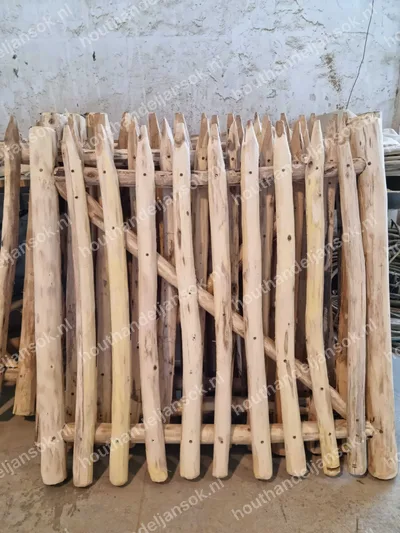
A fence panel is a complete panel in a frame, usually 180 × 180 cm, which you hang between two posts. It is quick to install and predictable in price, but the size is fixed. A fence board is a loose board, straight-edged, pressure-treated or as Douglas fir cladding, which you fix to rails or battens yourself. That takes more work, but you decide the height, overlap and pattern yourself. On a sloping garden or with a non-standard length, loose boards are almost always the better choice. You'll find both in our category screening and fences.
Which timber species should you choose?
For most gardens, Douglas fir is the standard choice: naturally class 3, a warm reddish-brown colour, and above ground it does not need to be pressure-treated. If the budget is tight or the timber will be in a zone that is always wet, pressure-treated pine is the more obvious choice; treated timber performs well close to the ground. If the boundary fence needs to last for decades, choose hardwood such as azobé or okan in class 1, with the price and weight that come with it. You can read about the trade-off between the first two in Douglas fir versus pressure-treated timber, and about choosing a cladding profile in Danish cladding: which timber species.
Frequently asked questions
Which brand supplies the best fence boards?
No seller wins on every point. DIY stores such as Gamma and Praxis are strong on price for simple pressure-treated boards, Hornbach on the breadth of its range, and webshops such as Garden Adventure and Tuinhout-direct on convenience. The quality of a fence board lies mainly in the timber species and the durability class (EN 350), not in the seller's logo.
What is the cheapest webshop for fences?
For standard pressure-treated fence boards, DIY stores are generally the cheapest per metre, especially if you collect them yourself. We don't claim to have the lowest price per click. Always look at the total price: price per metre plus posts, fixings, cutting and delivery costs. That is where the ranking regularly shifts.
What is the difference between a fence panel and a fence board?
A fence panel is a complete panel in a frame, usually 180 × 180 cm, which you hang between two posts. A fence board is a loose board that you fix to rails yourself. Panels are quicker to install; loose boards give you freedom in height and length, useful on a sloping garden or with a non-standard size.
What guarantee do I get on fence boards?
Pressure-treated timber often comes with a manufacturer's guarantee against wood rot and insects. The term varies by supplier and treatment. Untreated Douglas fir has no rot guarantee, but it does have its natural class 3. Greying, movement, small cracks and loose knots are properties of timber and are not covered by the guarantee. You also always have your statutory rights.
Is a fence delivered and installed?
Jan Sok delivers fence boards, posts and fixings from Meppel across the Netherlands; collection is also possible. You install it yourself or leave it to your landscaper or contractor. We supply the materials, cut to size and help you work out quantities and construction. Call 0522 851 551 or request a quote for a calculation for your situation.
What should I look for in value for money for fence boards?
Look beyond the price per metre. Also consider the timber species and durability class, the option of having it cut to size, how the posts go into the ground, the guarantee, the delivery costs and the fixings. A set of cheap boards on unprotected posts will cost you more within ten years than Douglas fir on concrete.