

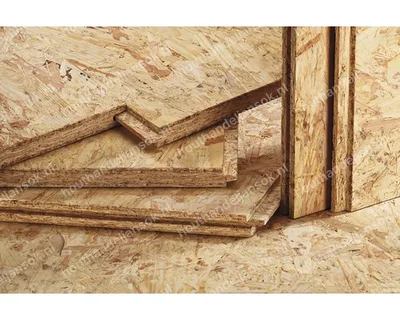
Is OSB water-resistant? Short answer: moisture-resistant, yes; waterproof, never. Only class OSB/3 under EN 300 is bonded with moisture-resistant glue and copes with construction moisture and a shower of rain during the build. Leave the board unprotected outdoors and the strands absorb water and the board swells for good. That distinction decides whether your floor or roof decking holds up. See also sheet materials, plywood and choosing PIR thickness.
The four OSB classes under EN 300
OSB is not classified by brand but by class, and that class is stamped on the board. There are four.
OSB/1 is non-structural, for dry, general use and furniture. OSB/2 is structural, but only in dry conditions. OSB/3 is structural and for humid conditions: the usual class in Dutch construction. OSB/4 is structural and heavy-duty, also for humid conditions.
In practice you will mainly come across OSB/2 and OSB/3. If you can't see a class marking anywhere, ask about it before you order. For floors and roof decking it really makes a difference.
What moisture-resistant does and does not mean
Moisture-resistant bonding means the glue bond does not give way under high humidity or temporary wetting. It explicitly does not mean the wood itself repels water. OSB is made of large wood strands, and wood absorbs water.
Once that happens the board swells, and that swelling does not go away. That is the point that surprises people most: an OSB board that has dried out again is not flat again. It stays thicker, the surface stays rough, and on a floor you feel it through your laminate.
Edges are the weak spot
From the factory, the board is pressed more densely at its outer faces. Cut through a board and you expose the open core, and that is exactly where the board soaks up water like a sponge. Two practical consequences:
- Seal cut edges with a primer, varnish or edge sealer before fitting the board.
- Don't leave boards lying on the ground on site. Keep them on a pallet with plastic underneath, and cover them when it rains. Not because the board breaks straight away, but because the edges will already have absorbed moisture before you start.
When should you not choose OSB?
If water is a constant factor, OSB is simply not the right material. Choose instead:
- Concrete plywood: water-resistant bonded with a sealed film layer, made for formwork and working platforms that get wet repeatedly.
- Fibre cement: moisture- and weather-resistant, suitable for facades and roofs.
- Chipboard V313: moisture-resistant for indoor spaces with fluctuating humidity, such as a bathroom cabinet.
OSB board thickness: which do you need?
Thickness follows from the span and the load, not from habit. As a rule of thumb for non-structural to lightly loaded work:
9 mm: wall sheathing, ceilings, infill panels. Not for floors. 12 mm: light sheathing and roof decking with small centre-to-centre spacing. 15 to 18 mm: floors and subfloors, roof decking. The standard for load-bearing work. 22 mm: larger spans and heavier loads.
Note the limit of this rule of thumb: for a structural floor or roof, the manufacturer's table determines the thickness, together with your joist spacing and the expected load. If in doubt, consult a structural engineer. We sell boards; we do not make structural calculations.
Which OSB thicknesses do we have in stock?
Two, and we would rather be clear about that than have you face a surprise when you come to collect:
- OSB 9 mm: 1.22 × 2.44 m, 2.98 m² per board, €19.10 (€6.42 per m²).
- OSB 18 mm: 0.61 × 2.44 m, 1.49 m² per board, €17.40 (€11.69 per m²). This is a half board, not a full size.
Prices incl. VAT, as of July 2026. Thicknesses such as 12, 15 and 22 mm are not in stock here. Get in touch if you need them and we will check whether our supplier can deliver them. Otherwise, browse the full OSB range.
OSB or underlayment?
The price difference turns out differently than most people expect. In 9 mm, underlayment costs €17.80 per board with us (€5.98 per m²), so slightly cheaper than OSB, while it is the smoother board. Choose OSB if the board has to work structurally and won't be on show. Choose underlayment for a flat subfloor or visible work. For treating underlayment, read treating underlayment against moisture.
Frequently asked questions
Is OSB water-resistant?
Moisture-resistant, yes; waterproof, never. Only OSB/3 is bonded with moisture-resistant glue and copes with construction moisture and temporary rain. Prolonged exposure makes the strands absorb water, after which the board swells for good.
Can OSB be left outside?
Not as a final application. During construction OSB/3 can survive a few wet days, but as a permanent outdoor board it fails. Use concrete plywood or fibre cement for that.
What happens when OSB gets wet?
The strands absorb water and the board swells, especially at cut edges where the core is exposed. After drying, the board stays thicker and rougher than it was. On a floor you will feel that unevenness through your floor covering.
What thickness of OSB board do I need for a floor?
15 to 18 mm for normal joist spacing. Our 9 mm is too thin for floors and is used for sheathing. For a structural floor, follow the manufacturer's span table and, if in doubt, consult a structural engineer.
What is the difference between OSB/2 and OSB/3?
Both are structural, but OSB/2 may only be used in dry conditions, while OSB/3 is bonded with moisture-resistant glue for humid conditions. In Dutch construction OSB/3 is the usual choice. The class is stamped on the board.
Which OSB board thicknesses does Houthandel Jan Sok supply?
Two: 9 mm at 1.22 × 2.44 m for €19.10 and 18 mm at 0.61 × 2.44 m for €17.40. That 18 mm is a half board, not a full size. Thicknesses such as 12, 15 and 22 mm are not in stock; get in touch if you need them.