

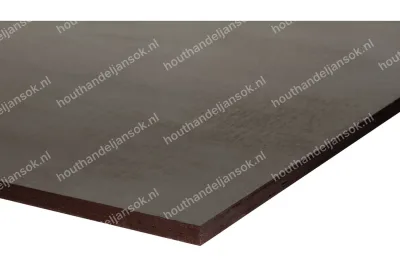
Short answer: plywood is a sheet made of thin layers of wood glued crosswise on top of each other. It is meant for dry or sheltered work. Concrete plywood is plywood with a hard, smooth film. That makes it better at withstanding knocks, moisture and wear. Do you have to choose between plywood and concrete plywood? At Houthandel Jan Sok in Meppel the common thicknesses are in stock, including 18 mm.
What is plywood?
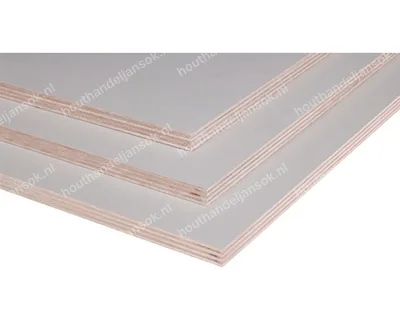
Plywood consists of thin layers of wood glued crosswise. This keeps the sheet more stable than solid wood of the same thickness and makes it less prone to warping. You use plywood for cabinets, interior walls, furniture and, in the right grade, for roof boarding. See the range under plywood.
What is concrete plywood?
Concrete plywood is plywood with a plastic film layer on both sides. It was originally made for formwork in construction. Today you also see it as a worktop, working platform, trailer floor and in other places where conditions are wet and rough. See concrete plywood in the shop.
The differences at a glance
Surface. Plywood has a visible wood veneer. Concrete plywood has a hard, smooth film.
Moisture. How well plywood copes with moisture depends on the grade and the bonding, but it is not meant to stand outside for long. Concrete plywood copes better with wet conditions, although you do need to seal the edges.
Wear. Plywood is reasonably hard-wearing. Concrete plywood is clearly tougher and handles knocks well.
Use. You use plywood mainly for furniture and interior work. Concrete plywood for worktops, floors and formwork.
Which thickness do you choose?
For many jobs 18 mm is the standard. For heavy loads you choose a thicker sheet, for light cladding a thinner one. You will find the current sizes in the shop. An overview of all our sheet materials is on timber boards & sheet materials, and in the guide sheet materials for building and the workshop you can read more about the other types.
How do you work with plywood and concrete plywood?
Cut both sheets with a fine-toothed saw. That keeps the edge neat. Concrete plywood has a layer on both sides that keeps water out. The cut edge does not have that layer. So paint or varnish that edge afterwards. Otherwise moisture gets in and the sheet can swell there.
Screw a few centimetres from the edge. Pre-drill thick sheets. Store sheets flat and dry on battens. That way they stay straight. Using a sheet outdoors? Then choose a sheet that is made for it and seal all the edges.
In short
Plywood is meant for indoors and dry places, while concrete plywood has a top layer that keeps water out. With both sheets you seal the cut edges and store them dry and flat. That keeps them looking good and straight.
Frequently asked questions
What is the difference between plywood and concrete plywood?
Concrete plywood is plywood with a hard film that protects against moisture and wear. Plywood has a wood veneer surface and is meant for drier work.
Can plywood be used outdoors?
Only temporarily, or with the right grade and finish. For places that are always wet, choose concrete plywood, fibre cement board or another exterior board.
What does 18 mm plywood cost?
That depends on the grade and the size. Current prices are listed per product in the shop.
What thickness of plywood or concrete plywood do I need?
For a lot of work 18 mm is the standard. Go thicker for heavy loads. Check the current sizes in the shop.
Plywood or concrete plywood: which sheet do you choose?
Plywood usually suits dry or suitably finished sheet work. Concrete plywood more often suits formwork and temporary working platforms because of the film coating. Check the moisture exposure and the edges.
Where can you buy plywood or concrete plywood in the Netherlands?
At Houthandel Jan Sok in Meppel, online or at the yard. The shop shows current sizes, prices and stock, and delivery across the Netherlands is possible.
Plywood or concrete plywood: which sheet do you choose?
| Property | Plywood | Concrete plywood |
|---|---|---|
| Construction | Crosswise bonded veneer layers | Plywood with a hard film coating |
| Typical use | Furniture, walls, floors and dry sheet work | Formwork and temporary working platforms |
| Moisture | Depends on sheet grade and bonding | More resistant to temporary moisture and wear, edges remain a point of attention |
| Example 18 mm | 1.22 x 2.44 m, 2026 price level from €69.70 | 1.25 x 2.50 m, 2026 price level from €74.80 |
Where can you buy plywood or concrete plywood in the Netherlands?
Houthandel Jan Sok in Meppel supplies plywood and concrete plywood online and from the yard at Celsius 10. The shop shows the current size, price and stock. Delivery across the Netherlands is possible. Choose plywood for dry or suitably finished sheet work and concrete plywood when the film coating is an advantage for formwork or a temporary working platform. With long-term exposure to moisture, the coating is not the only deciding factor; discuss sheet grade, edges and fixing.