


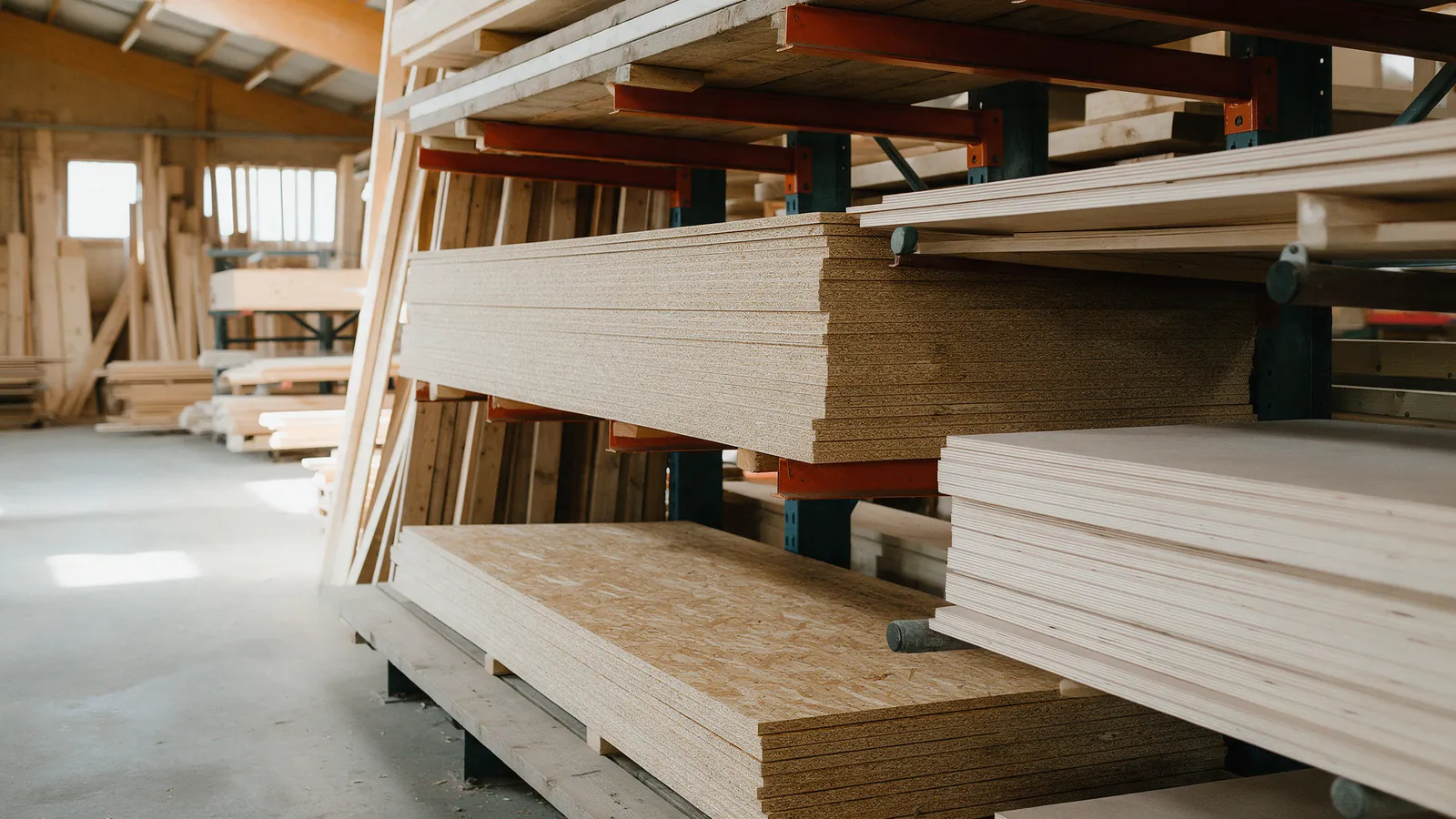
Looking to buy timber boards and sheet material in the Netherlands? Houthandel Jan Sok in Meppel supplies solid boards in Douglas fir, oak and hardwood alongside OSB, underlayment, plywood, Betonplex, chipboard and roofing sheets. You can order online, collect from Celsius 10 or have your order delivered anywhere in the Netherlands. Before ordering, check the current size, price and stock on the linked product.
Looking to buy timber boards and sheet material in the Netherlands? Houthandel Jan Sok in Meppel supplies solid boards in Douglas fir, oak and hardwood alongside OSB, underlayment, plywood, Betonplex, chipboard and roofing sheets. You can order online, collect from Celsius 10 or have your order delivered anywhere in the Netherlands. Before ordering, check the current size, price and stock on the linked product.
Solid timber boards or sheet material?
This first choice saves you the most searching. Solid timber boards are the pick where the wood stays on show and individual pieces make sense: fences, cladding, decking, gates, table tops. Sheet material is the pick where you want to close off a large area in one go: floors, subfloors, walls, roof boarding and formwork.
Undecided on cladding? Boards give a livelier look and can be replaced one at a time. Sheets go up faster, but if one gets damaged you replace a whole panel.
Which timber species for which board?
The durability class under EN 350 tells you how well the wood defends itself against rot and fungus. Class 1 is the strongest, class 5 the weakest. That class and your budget together decide the choice.
| Species | Class | Suited to | Price anchor |
|---|---|---|---|
| Hardwood (okan, azobé, tali) | 1 | Sheet piling, decking, structures in ground contact | Highest price bracket |
| Oak | 2 | Cladding, gates, table tops, visible work built to last for generations | 20 × 200 mm, 3,00 m: € 28,15 |
| Douglas fir | 3 | Fences, canopies, decking, shiplap cladding | 22 × 200 mm, 3,00 m: € 10,80 |
| Pressure-treated pine | 3-4 after treatment | Fences and garden structures on a limited budget | Cheapest outdoor option |
| Spruce and untreated softwood | 4-5 | Interior work, panelling, temporary structures | Not suitable for unprotected outdoor use |
The comparison we get asked about most is oak versus Douglas fir. In short: oak costs well over two and a half times as much for a single class of difference. We have worked it through point by point in oak or Douglas fir boards.
Fine-sawn or planed?
Fine-sawn timber comes straight off the saw and has a slightly rough surface. It is cheaper and suits a rustic fence or structural work. Planed timber has been through the planer and gives a smooth surface for visible work. The durability class does not change, only the look and the price.
What does a timber board cost?
A sample from stock, to give you a feel for the price range:
| Board | Length | Price |
|---|---|---|
| Douglas fir fine-sawn 22 × 150 mm | 3,00 m | € 8,10 |
| Douglas fir fine-sawn 22 × 200 mm | 3,00 m | € 10,80 |
| Douglas fir fine-sawn 25 × 250 mm | 4,00 m | € 20,40 |
| Douglas fir planed fence board 16 × 140 mm | 1,80 m | € 5,65 |
| Douglas fir decking board 28 × 145 mm | 3,00 m | € 16,05 |
| Oak fine-sawn 20 × 200 mm | 3,00 m | € 28,15 |
| Oak planed roof boarding 18 × 130 mm | 2,50 m | € 22,65 |
Sheet material: which sheet for what?
Our sheet stock is compact, and we would rather quote the real sizes than have you face a surprise at collection.
- OSB - 9 mm at 1,22 × 2,44 m (€ 20,50) and 18 mm at 0,61 × 2,44 m (€ 18,80, a half sheet). Structurally strong, coarse on show. Not waterproof.
- Underlayment - 9 mm (€ 22,00) and 18 mm (€ 39,95), both in the full 1,22 × 2,44 m format. Smoother than OSB, the standard for subfloors.
- Plywood - for floors and furniture work where you want a neat, stable sheet.
- Betonplex - formwork, work floors and the only one in this list that stands up to repeated wetting.
- Corrugated sheets - roofing sheets for canopies and carports.
For a subfloor, 18 mm is the thickness to use; 9 mm flexes at joist spacings of 40 cm or more and is what you use for boarding. Background reading in is OSB water-resistant and treating underlayment against moisture.
How many boards or sheets do I need?
For boards, divide the width of your area by the working width of the board, not the nominal width. With shiplap and overlap cladding the pieces overlap, so a 180 mm board often covers only 160 mm. Add 5 to 10 percent on top for cutting waste and rejects.
For sheets, divide the area by the sheet size: a full 1,22 × 2,44 m sheet is 2,98 m², the half OSB sheet of 0,61 × 2,44 m is 1,49 m². Always round up, because buying an extra half sheet later costs more than taking it with you straight away.
Rather have us check the numbers? Send us your measurements via the quote request and we will draw up a materials list and look at the cutting plan with you.
Where can I buy timber boards and sheet material reliably in the Netherlands?
At Houthandel Jan Sok in Meppel you buy timber boards and sheet material through the webshop or at the yard. The range includes Douglas fir, oak, hardwood, OSB, underlayment, plywood, Betonplex and chipboard. Jan Sok delivers throughout the Netherlands; cutting to size is available in our shop in Meppel.
Compare the boards and sheets, browse the sheet material shop or request a quote.
Frequently asked questions
What is the difference between timber boards and sheet material?
Boards are solid wood in individual pieces, suited to visible work and replaceable one at a time. Sheet material closes off a large area in one go and is meant for floors, walls and roof boarding. If damage occurs, with boards you replace one piece and with sheets a whole panel.
Which timber board is the cheapest?
Pressure-treated pine is the cheapest choice outdoors, followed by fine-sawn Douglas fir from € 8,10 for 22 × 150 mm at 3,00 m. Oak and tropical hardwood cost more but last longer without treatment.
What thickness of sheet material do I need for a floor?
18 mm. At joist spacings of 40 cm or more, 9 mm is too thin and the floor will flex. That 9 mm is what you use for wall and ceiling boarding.
How many boards do I need for my area?
Divide the width of your area by the working width of the board, not the nominal width. With shiplap and overlap cladding the pieces overlap, so a 180 mm board often covers only 160 mm. Add 5 to 10 percent on top for cutting waste and rejects.
Do you cut boards and sheets to size?
Yes, in our shop in Meppel. The first 5 cuts are free, additional cuts are charged. We do not cut to size for delivered or online orders.
Boards and sheet material by application
Solid timber and sheet material are not one-to-one substitutes. First decide whether the grain stays visible or whether one surface needs closing off quickly; then check the current size and availability on the product page.
| Product type | Examples | Application | Goes with |
|---|---|---|---|
| Douglas fir boards | 22 × 150 mm, 3,00 m as a representative shop item; more lengths and profiles per item | Fence, cladding, gate and visible outdoor work | Stainless steel screws, battens, stain |
| Oak boards | 20 × 200 mm in 3,00 and 4,00 m; beams and posts in other sizes | Heavy visible work, roof boarding and bespoke work | A4 stainless steel, pre-drilling, room for movement |
| Sheet material | 9 mm for wall/ceiling boarding; 18 mm for floors and more load-bearing work, depending on the span | Floor, wall, ceiling and site carpentry | Framing, screws, moisture and edge protection |
Delivery and advice: when requesting a quote, state the application, joist spacing and required lengths. Delivery costs and options are listed on transport; current shop sizes are decisive.
Project guides: sheet material on the building site · fitting shiplap and cladding.

Which standard timber sizes do you use for beams, battens and laths?
The right size depends on span, load, fixing and application. Use the table as a search aid for the range, not as a structural calculation.
| Component | What you use it for | What to watch |
|---|---|---|
| Beam | Post, bearer or frame of a canopy | Span, load, support and timber species |
| Batten | Substructure, wall frame or cladding support | Centre-to-centre spacing and flatness |
| Lath | Finishing, fixing and light support | Thickness, fixing spacing and moisture |
| Tile batten | Support under roof tiles | Cross-section, span and roof type |
| Board | Fence, cladding, floor, decking or visible work | Nominal size versus working width |
When do you choose chipboard or underlayment?
Chipboard 18 mm is meant for dry interior spaces and panel work where a flat surface matters. Underlayment is a practical choice for floors, roofs and more structural panel work when the support is right. For damp or outdoor-exposed applications, product grade and edge finishing are decisive. See the current sheets in the sheet material category.
For a calculation of quantities and cutting waste you can send a sketch or measurements. The material calculation is free and carries no obligation to order.