

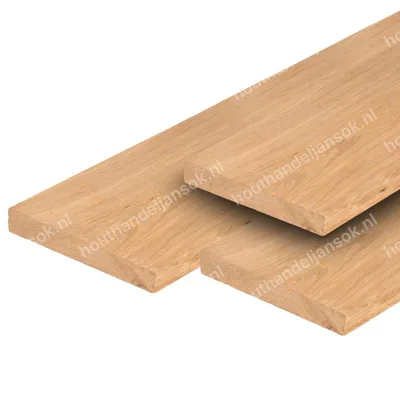
Oak or Douglas fir boards? Short answer: Douglas fir for almost everything in the garden, oak for visible work that has to last for generations. The price difference is at the heart of the choice. A fine-sawn oak board of 20 × 200 mm at 3.00 m costs €28.15 with us. A Douglas fir board of 22 × 200 mm at the same length costs €10.80. So you pay well over two and a half times as much for a difference of one class. (Prices including VAT, price level July 2026.)
The differences at a glance
| Feature | Oak | Douglas fir |
|---|---|---|
| Durability class (EN 350) | 2 | 3 |
| Density | approx. 700 kg/m³ | approx. 510 kg/m³ |
| Colour when new | light golden brown with flame figure | warm reddish brown and resinous |
| Untreated after years | silver-grey | silver-grey |
| Fixing | stainless steel required because of tannic acid | galvanised is fine, stainless steel is neater |
| Working | hard, pre-drilling needed | softer, screws in without fuss |
| Board 20-22 × 200 mm, 3.00 m | €28.15 | €10.80 |
What the class really means
The durability class tells you how well the timber defends itself against rot and fungi, without any treatment. Oak heartwood is in class 2 and easily lasts 25 years above ground. Douglas fir is in class 3 and lasts 10 to 15 years untreated above ground. So oak lasts roughly twice as long, but it also costs well over two and a half times as much.
More importantly: in direct ground contact neither is the right choice. For that you use hardwood or pressure-treated pine in use class 4, or you set the timber on a concrete post base so that the end grain stays dry. Anyone who sells you oak posts to put permanently in the ground is selling you a problem five years down the line.
The difference people underestimate: tannic acid
Oak contains tannic acid, and that has two practical consequences that rarely appear in tables.
First: in contact with galvanised or untreated steel, tannic acid causes blue-black stains around every screw, plus damage to the fixing itself. On façade cladding these stains are visible within one season. With oak, stainless steel is therefore not a recommendation but a requirement, outdoors preferably A4.
Second: rainwater running off new, untreated oak can stain light-coloured paving, brickwork and render brown in the first year. It fades, but it surprises people who have just had light patio slabs laid. Take this into account when installing.
Weight and working
Oak weighs approx. 700 kg per m³ against approx. 510 kg per m³ for Douglas fir, so about 35 percent more. On a single board that is manageable. On beams and lengths of 5.00 m you notice it straight away, and sometimes it means a second person or a forklift.
On top of that, oak is hard. Pre-drilling is not a luxury: without pre-drilling the board splits at the end. Pre-drill at about 70 percent of the screw diameter and keep at least 2 cm from the end. Douglas fir screws in without fuss, and on a twenty-metre fence that saves half a day's work.
Which do you choose for each job?
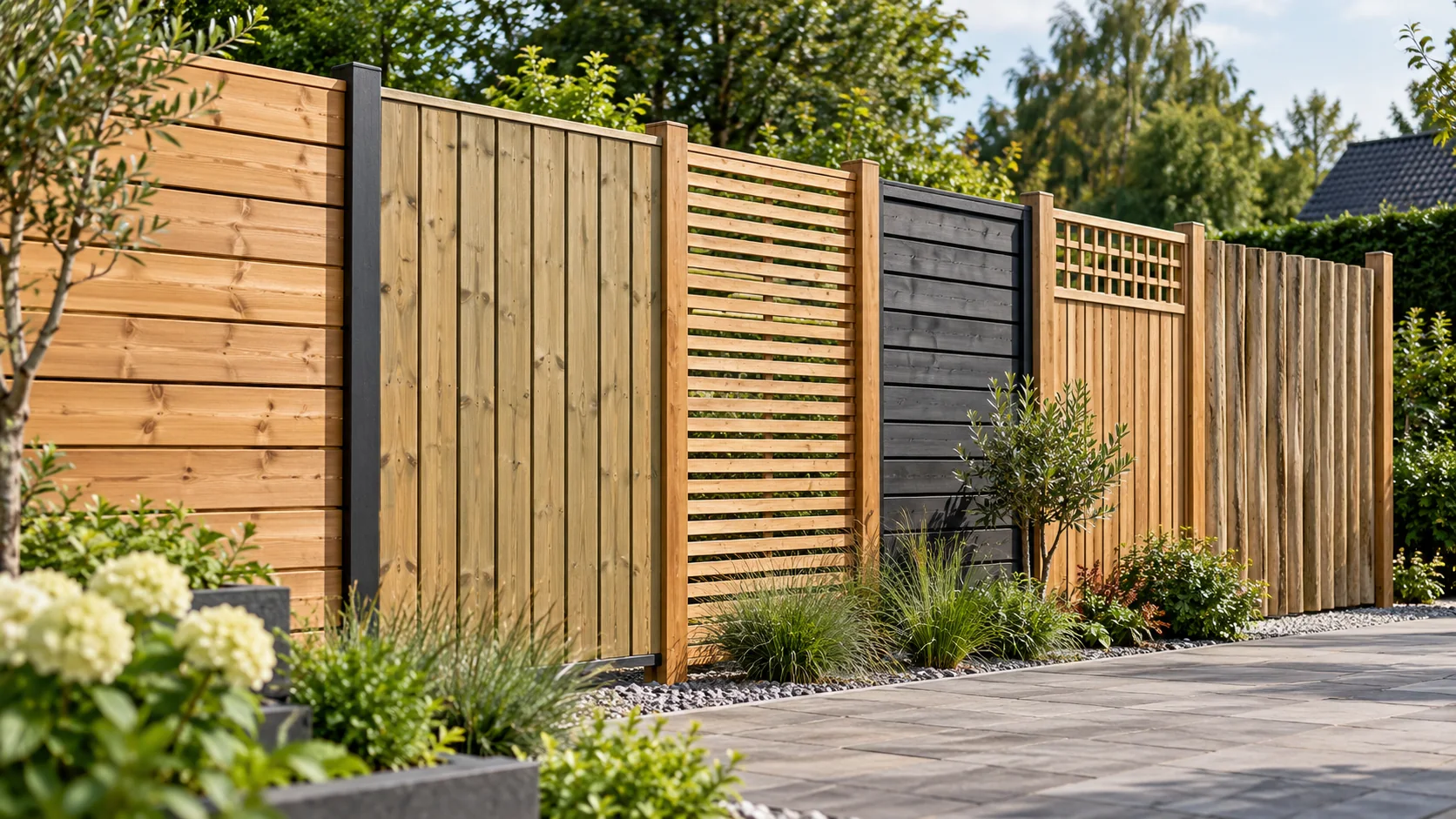
- Fence: Douglas fir. It is cheaper, lighter, available in more sizes and easier to work. Oak is rarely worth the investment here, because a fence is mainly functional.
- Façade cladding: both work. Choose oak if the façade is the building's calling card and the budget is there, and Douglas fir cladding if you want a good result for a third of the price.
- Decking or patio: Douglas fir. We deliberately do not supply oak as decking boards: on a wet, horizontal surface tannic acid leaches out, and that stains the paving underneath.
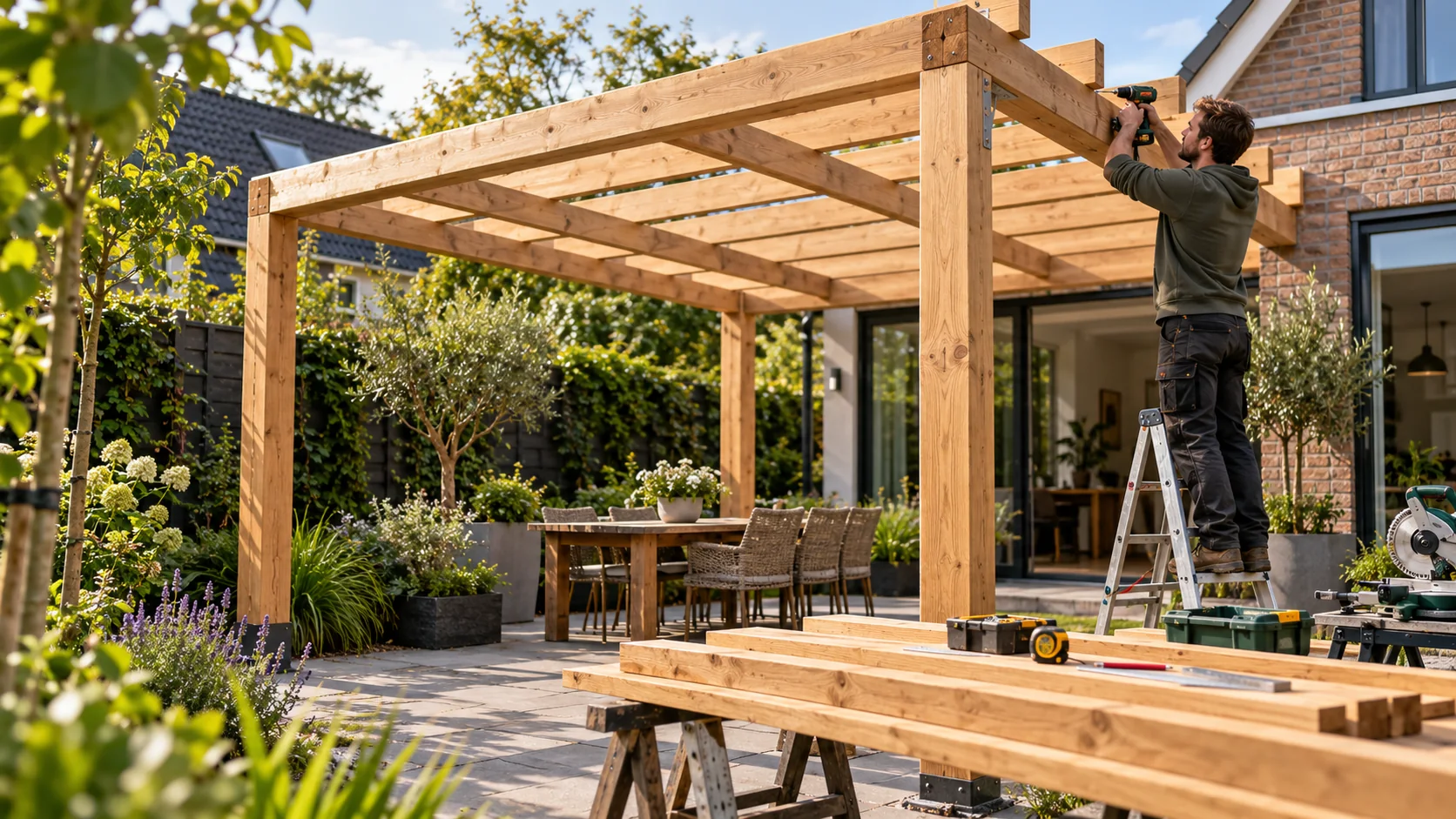
- Canopy or carport: Douglas fir. Structurally, class 3 is perfectly fine here, and the weight difference in beams is the argument that settles it.
- Table top, bench, gate or boundary feature with character: oak. Here you pay for the flame figure and the hardness, and you notice that every day.
- Bank protection or ground contact: neither. Use azobé, okan or pressure-treated pine.
Available sizes: this is where there is a practical difference
Our Douglas fir range is considerably wider than our oak range, and sometimes that makes the choice for you. In Douglas fir we have fine-sawn 22 × 150, 22 × 200, 25 × 250 and 32 × 200 mm in lengths up to 5.00 m, plus planed fence boards and decking boards in more widths. In oak the board is 20 × 200 mm in 3.00 and 4.00 m, alongside planed roof boarding 18 × 130 mm and planed shiplap cladding 18 × 180 mm.
Need a specific oak size? Request a quote. Then we will check what the sawmill can supply and what it costs.
Maintenance
Both timber species turn silver-grey when untreated, without any loss of durability. If you want to keep the original colour, treat the timber with oil every year. With both, always treat the end grain, because that is where water penetrates fastest. More on this in maintaining Douglas fir.
Frequently asked questions
What is the biggest difference between oak and Douglas fir for boards?
The price, followed by the fixing. Oak costs well over two and a half times as much (€28.15 versus €10.80 for a 3.00 m board) and requires stainless steel because of tannic acid. Oak is one class higher, approx. 35 percent heavier and has to be pre-drilled.
Is oak worth the extra cost over Douglas fir?
For visible work that has to last for decades, such as a gate, table top or a façade on show: yes. For a fence, decking or canopy, Douglas fir is almost always the smarter choice, because there you are mainly paying for function and not for looks.
Can I combine oak and Douglas fir boards?
Technically yes, but do not place oak above Douglas fir. Tannic acid running off the oak with rainwater leaves streaks on the Douglas fir below. Both also turn grey at a different rate, so a mixed surface stays visibly mixed.
Which screws do I use for oak and Douglas fir?
For oak always stainless steel, outdoors preferably A4, because tannic acid causes blue-black stains with galvanised steel. For Douglas fir galvanised is sufficient, although stainless steel weathers more neatly there too and leaves no rust streaks.
Is oak or Douglas fir better for ground contact?
Neither. Oak in class 2 performs well above ground, but for permanent ground contact you need use class 4: hardwood such as Azobe or Okan, or pressure-treated pine. A concrete post base under the post is the alternative.